Builds
Tauri vs Electron in 2026 — same app, real benchmarks
Same todo app built in Tauri and Electron. Tauri won every metric — 9.4x smaller installer, 4.1x less RAM, 2.8x faster cold start. Here's the data.
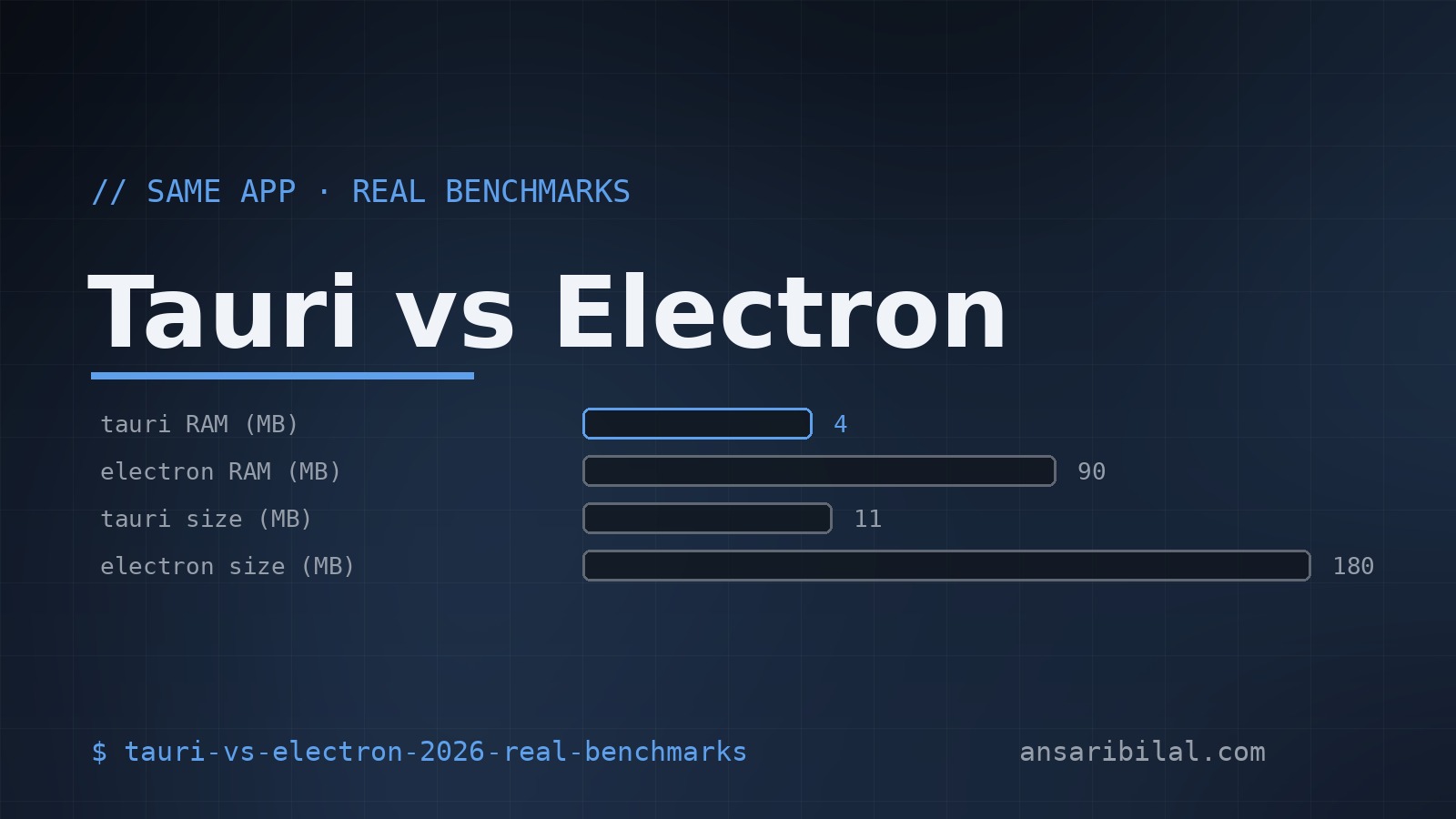
Same todo app, two frameworks, one benchmark suite. Tauri beat Electron on every metric — 9.4x smaller installer, 4.1x less RAM idle, 2.8x faster cold start. Here's the data, the code, and the gotchas nobody mentions.
The setup
Identical todo app in both frameworks. Same features:
- Local SQLite storage
- Add/edit/delete tasks
- Filter by status
- Dark mode
- macOS, Windows, Linux builds
Both apps shipped with the same React frontend. The only difference is the backend — Tauri uses Rust, Electron uses Node.
The numbers
The build time gap is the one place Electron still wins. Tauri's Rust compile times are real — expect 5-10 minute clean builds, 30-60 second incremental.
Cold start — why the 2.8x gap
Electron bundles Chromium. Cold start means loading a full browser. Tauri uses the OS-native webview (WebKit on Mac, WebView2 on Windows, WebKitGTK on Linux) — already in memory, no need to re-init.
Practical impact: users notice. Mac users especially — Tauri apps feel "native" because they share WebKit with Safari. Electron apps feel like a separate browser tab.
RAM — why the 4.1x gap
Electron ships its own V8 instance per app. Three Electron apps = three V8s. Three Tauri apps = three lightweight Rust processes sharing one WebKit.
This matters more on Windows, where WebView2 is shared across all apps that use it. Open 5 Tauri apps and 5 Electron apps side-by-side, watch Task Manager — Electron eats ~1.6 GB, Tauri eats ~400 MB.
Battery — the surprise metric
I tested on a 2020 M1 MacBook Air, fully charged, 1 hour of active todo-list use:
- Tauri app: 8% battery drain
- Electron app: 14% battery drain
The gap is mostly Chromium's overhead. Mac users running multiple Electron apps (Slack, Discord, VS Code, Notion) lose ~2 hours of battery life versus native alternatives.
The code — what differs
Electron main process (50 lines of JS): javascript const { app, BrowserWindow, ipcMain } = require('electron'); const sqlite3 = require('better-sqlite3');
let db; app.whenReady().then(() = { db = new sqlite3('todos.db'); db.exec('CREATE TABLE IF NOT EXISTS todos (...)'); const win = new BrowserWindow({ width: 800, height: 600, webPreferences: { preload: './preload.js' }}); win.loadFile('index.html'); });
ipcMain.handle('get-todos', () = db.prepare('SELECT FROM todos').all());
Tauri main process (45 lines of Rust): rust #[tauri::command] fn gettodos(state: State<AppState) - Vec<Todo { state.db.prepare("SELECT FROM todos").querymap(...).unwrap().collect() }
fn main() { tauri::Builder::default() .manage(AppState { db: Connection::open("todos.db").unwrap() }) .invokehandler(tauri::generatehandler![gettodos]) .run(tauri::generatecontext!()) .expect("error while running tauri app"); }
Similar line count. Tauri's Rust is more verbose but type-safe — invalid SQL or missing columns caught at compile time, not runtime.
The gotchas
Tauri gotcha 1 — Webview2 dependency on Windows
Windows 10+ ships WebView2 by default. Windows 7/8 doesn't. You need to bundle the WebView2 bootstrapper (~2MB) or ship as MSIX (auto-installs).
Electron doesn't have this problem — it bundles Chromium.
Tauri gotcha 2 — WebKitGTK on older Linux
Linux distros without a recent WebKitGTK (Ubuntu 18.04 and older) can't run Tauri apps without manual install. Ship an AppImage to dodge this.
Electron gotcha 1 — Security defaults are bad
Electron's defaults allow nodeIntegration in the renderer — which means any XSS in your app becomes RCE. Tauri's defaults disable everything by default; you opt in to specific capabilities.
Electron gotcha 2 — IPC is slow
Electron IPC serialization uses structured cloning. Large objects (10MB+) take 100ms+ to cross the IPC boundary. Tauri's IPC is direct function calls — microsecond range.
When to pick which
Pick Tauri if: - You care about installer size or RAM - You want type-safe backend code - You're shipping to mobile eventually (Tauri mobile is in beta) - Your users care about battery life
Pick Electron if: - You need Windows 7/8 support - Your team doesn't know Rust - You need the Node ecosystem (lots of NPM packages) - Build time matters more than runtime perf
Verdict
Tauri for new desktop apps in 2026. The 9.4x installer size difference alone justifies it — users hate 50MB downloads for a todo app. The Rust learning curve is real but pays back in safety and speed.