Insights
Rust ownership — the model that finally clicked after 90 days
I fought the Rust borrow checker for 90 days. Then 3 rules made it click. Common patterns: clone vs reference vs Box, when each is right.
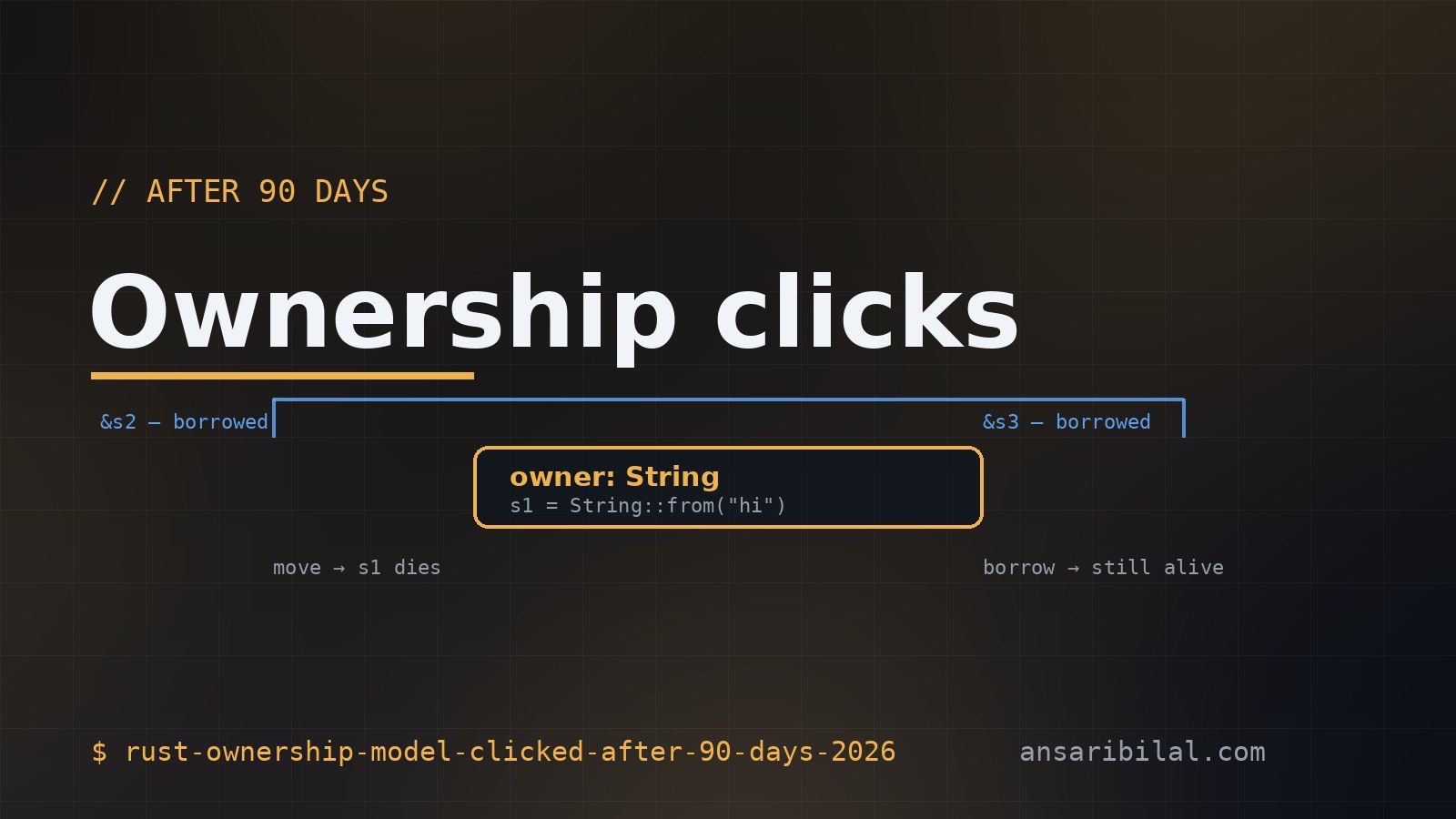
I fought the Rust borrow checker for 90 days. The click happened on day 91, when three rules finally made ownership make sense. Here's the rules, the patterns that work, and why the click is worth the fight.
Why ownership is hard
Most languages hide memory management from you. You create objects, the GC eventually cleans them up, and you don't think about who "owns" what.
Rust doesn't hide it. Every value has exactly one owner. When the owner goes out of scope, the value is dropped. The borrow checker is just a compile-time check that you're not lying about who owns what.
The hard part isn't the rules — they're simple. The hard part is changing how you think about data flow. You stop thinking "I have an object" and start thinking "I have temporary access to an object owned by someone else."
The 3 rules that made it click
Rule 1 — Ownership is about lifecycle, not access
Bad mental model: "Who can read this value?"
Good mental model: "Who is responsible for cleaning this value up?"
When you think about lifecycle, the rules click:
fn main() { let v = vec![1, 2, 3]; process(v); // println!("{}", v); // ERROR: v was moved }
You don't lose access — you lose responsibility. After process(v), v is gone because process is now responsible for cleaning it up.
Rule 2 — Borrow when you want to look, not own
fn main() { let v = vec![1, 2, 3]; peek(&v); println!("{}", v.len()); // OK — v still ours }
& means "let me look at this, but I won't take responsibility for it." The caller keeps ownership.
The click: borrowing is the default. Only take ownership when you actually need to destroy or replace the value.
Rule 3 — Lifetime annotations are about scope, not existence
When you write:
You're saying: "The returned reference lives at most as long as s does." It's a scope constraint, not a lifetime declaration.
You almost never write lifetime annotations in application code — the compiler infers them. You write them in function signatures and struct definitions where the compiler needs help.
The patterns that actually work
Pattern 1 — Clone early, optimize later
// Or just take ownership and clone at the call site: fn main() { let v = vec![1, 2, 3]; process(v.clone()); // explicit — caller knows it's cloned }
Yes, clones are "wasteful." They're also correct, obvious, and let you ship. Once your code works, profile and remove clones where they matter. Most clones don't matter — 90% of "performance" clones never show up in profiles.
Pattern 2 — References for read, ownership for write
// Writing — take ownership and return fn withdoubled(mut nums: Vec<i32) - Vec<i32 { for n in &mut nums { n = 2; } nums }
Reading doesn't change the data, so borrow. Writing needs exclusive access, so take ownership (or use &mut).
Pattern 3 — Box for "I don't know the size at compile time"
Recursive types need indirection. Box puts the value on the heap and gives you a pointer — the size is known at compile time (it's just a pointer).
Pattern 4 — Arc<Mutex<T for shared mutable state across threads
let shared = Arc::new(Mutex::new(vec![1, 2, 3]));
let sharedclone = Arc::clone(&shared); std::thread::spawn(move || { let mut data = sharedclone.lock().unwrap(); data.push(4); });
Arc (Atomic Reference Counted) lets multiple threads share ownership. Mutex ensures only one thread mutates at a time. This is the standard pattern — learn it once, use it everywhere.