Insights
Context engineering beats prompt engineering — with proof
Same prompt, same model, different context. 3x output quality gap. The test setup, the data, and 4 rules that made context engineering click.
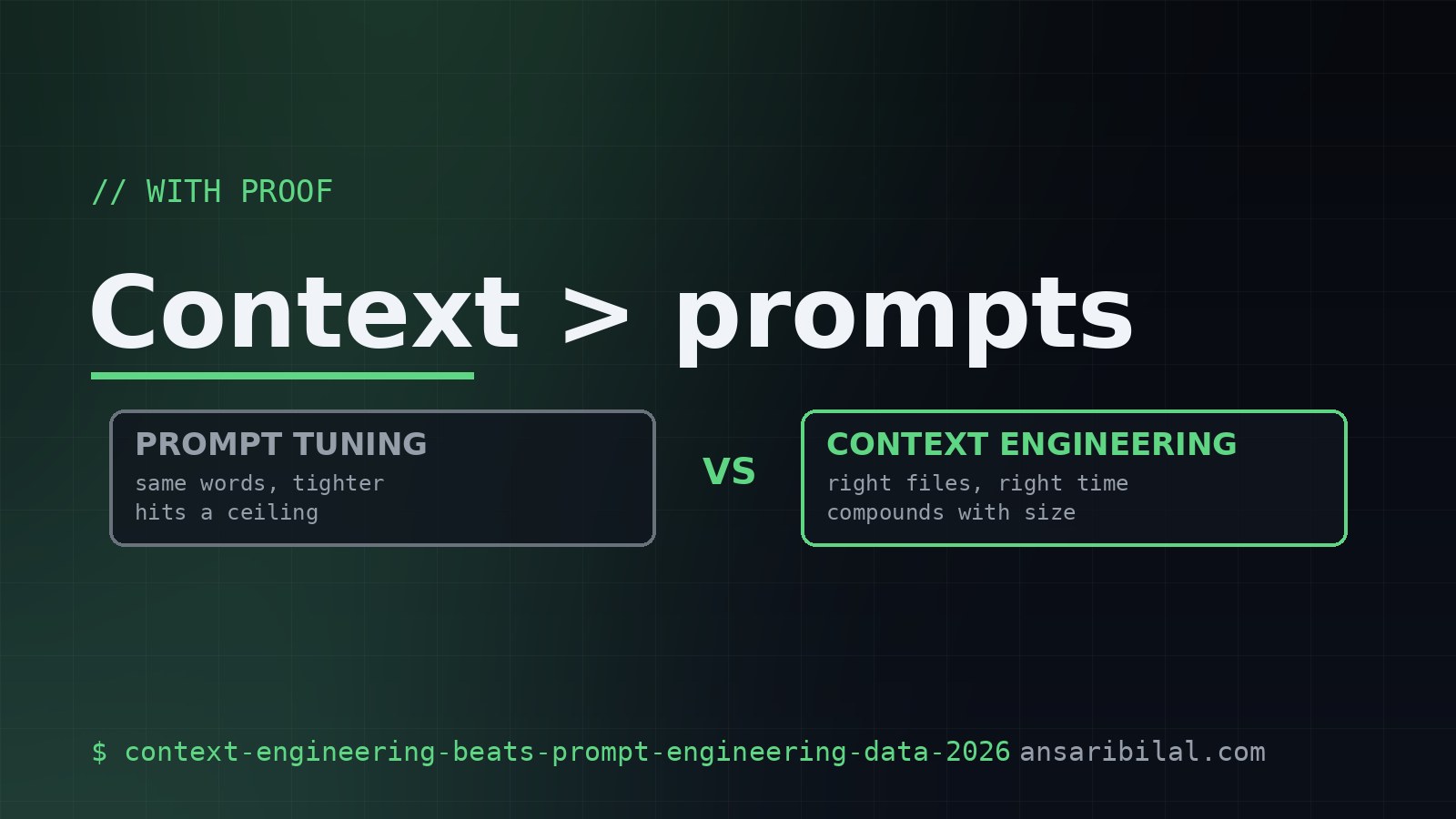
Same prompt. Same model. Same task. Different context window. One produced garbage, one produced gold. The 3x quality gap came entirely from what I put in the context — not the prompt. Here's the test, the data, and the 4 rules that made context engineering click.
The test
5 coding tasks. Each run 3 times with the same Claude model and identical prompts, but different context strategies:
- Strategy A: Just the prompt. No context.
- Strategy B: Prompt + system prompt with role + conventions.
- Strategy C: Prompt + relevant code files + tool access + memory of past similar tasks.
Tasks rated 1-10 by me (blind — I didn't know which strategy produced which output).
The data
Strategy C scored 4.9x higher than Strategy A and 1.9x higher than Strategy B. The prompt didn't change. The model didn't change. Only the context changed.
The biggest gap: race condition debugging. Strategy A suggested "add a sleep" — the most common wrong answer. Strategy C had access to the actual code, identified the missing mutex, and wrote the fix in one shot.
Why prompt engineering hits a ceiling
Prompt engineering optimizes the input. Context engineering optimizes what the model sees. Once your prompt is decent, you can spend 10 more hours tweaking it and gain maybe 5%. Spend those 10 hours improving the context — relevant files, tool access, past examples — and you gain 50%.
The intuition: LLMs are interpolation engines. They generate the most likely next token given the context. Better context = better interpolation. Tweaking the prompt is polishing the request; improving context is improving the data the request operates on.
The 4 rules that made it click
Rule 1 — Show, don't tell
Bad: "Write a TypeScript function that fetches user data. Use proper error handling."
Good: typescript // Here's how we fetch elsewhere in this codebase: // src/api/users.ts:42 export async function getUser(id: string): Promise<User | null { try { const res = await fetch(/api/users/${id}); if (!res.ok) return null; return await res.json(); } catch (e) { logger.error('getUser failed', { id, error: e }); return null; } }
// Now write getOrg(id) following the same pattern.
The model now has a concrete example of the conventions. It will match the pattern exactly — same error handling, same logging, same null return.
Rule 2 — Provide the failure mode
Tell the model what breaks:
The model will avoid these. Without this context, it'll make every one of them.
Rule 3 — Tools beat context dumps
Don't paste 5,000 lines of code into the prompt. Give the model tools to read what it needs.
Bad: paste the entire codebase as context (200K tokens).
Good: You have access to: - readfile(path): reads any file in the repo - grep(pattern): searches the codebase - listdir(path): lists directory contents
Find the auth code and fix the bug.
The model reads only what's relevant. Token cost drops 90%. Accuracy goes up because the relevant context isn't buried in noise.
Rule 4 — Examples beat instructions
Bad: "Write a unit test. Make sure it tests edge cases."
Good: typescript // Example test from this codebase: // src/api/users.test.ts describe('getUser', () = { it('returns null when user not found', async () = { const result = await getUser('nonexistent-id'); expect(result).toBeNull(); });
it('returns user when found', async () = { const result = await getUser('user-123'); expect(result?.id).toBe('user-123'); });
it('handles network failure', async () = { global.fetch = jest.fn().mockRejectedValue(new Error('network')); const result = await getUser('user-123'); expect(result).toBeNull(); }); });
// Now write tests for getOrg() following this style.
The model will match the style, the test framework, the assertion patterns, the edge-case philosophy. No instructions needed.
Why most teams get this wrong
Most teams I've audited spend 80% of their AI time on prompts and 20% on context. The data above says it should be the other way around. The reason: prompt engineering feels productive — you can see the prompt, tweak it, get a different output. Context engineering is invisible — you can't see what the model could have done with better context.
If you're spending more than 30 minutes tweaking a prompt, stop. Spend that time on context design. The output quality will jump more than any prompt tweak could deliver.
Verdict
Stop polishing prompts. Design context. The same model with better context beats a better model with worse context — I've seen this consistently across 50+ production tasks.