Insights
OpenAI's Daybreak Turns Security Into an Agent Loop — Red Team Attacks, Defense Factory Patches (2026)
OpenAI unveiled Daybreak Red Team and Daybreak Defense Factory on Nov 12, 2026: agent teams that probe web apps for real flaws and draft tested patches for human review. Early access and research preview — no pricing yet.
Last updated: November 14, 2026 · 3-minute read
OpenAI reports that a recent internal security sprint mobilized 250+ people and closed 53 urgent or high-priority issues on the first day. That sprint is how OpenAI built its own Defense Factory, one of two products OpenAI unveiled at its Cyber at the Frontier keynote on Nov 12, 2026.
What Daybreak Is
Daybreak is OpenAI's cybersecurity program. It brings together AI capabilities, security solutions, partners, and support to help defenders protect the systems people rely on. Access is by application. OpenAI verifies applicants and reviews how they plan to use the models before approving access. See the Daybreak hub and The Defense Factory.
Daybreak Red Team
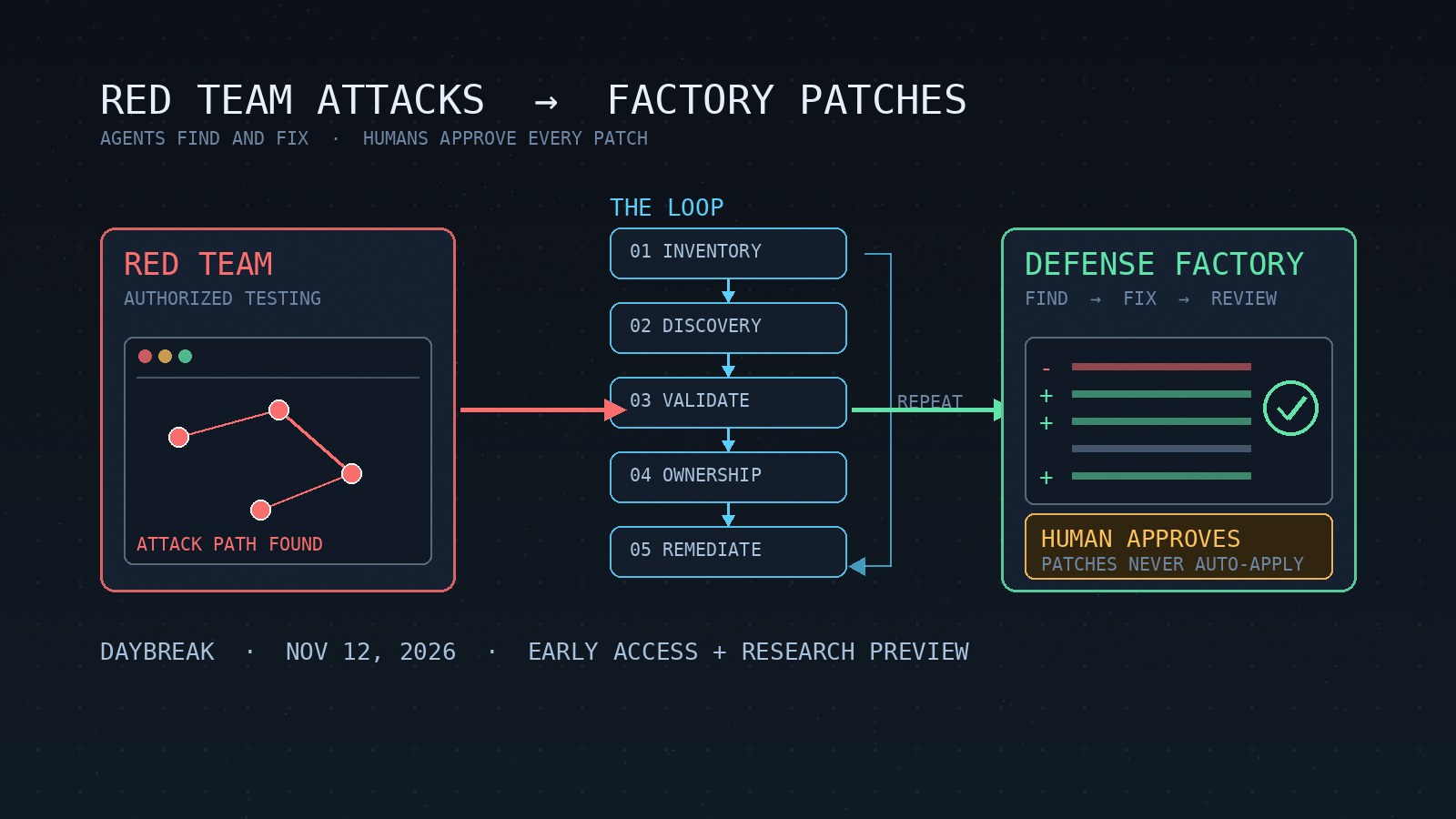
Daybreak Red Team is for authorized security testing. Teams of AI agents probe a web application, explore attack paths using source code and application context, validate reported vulnerabilities, and test fixes. It is in early access, and organizations apply for it.
Daybreak Defense Factory
Daybreak Defense Factory is a continuous, agent-first operation for finding and fixing vulnerabilities. Agents scan code, validate findings, and prepare tested patches for review. It is available in research preview as a plugin installed from the ChatGPT plugin marketplace. Users connect a GitHub repository and choose "Repository" for a one-off scan or "Commit changes" for ongoing monitoring of new commits. A scan may take several hours for a larger repository.
The Defensive Loop
OpenAI describes five steps: 01 Inventory (map, link, update), 02 Discovery (scan, analyze, import), 03 Dynamic validation (reproduce, test, confirm), 04 Ownership assignment (identify, route, follow up), 05 Verified remediation (patch, deploy, verify). People review consequential changes and independently verify deployed fixes.
OpenAI's Internal Sprint Numbers
From OpenAI's own account of building its internal factory: a recent security sprint mobilized 250+ people; 53 urgent or high-priority issues were closed on the first day; accepted ownership assignments reached 90.6%; 37% of findings were identified as duplicates; 19.5% of findings were reproduced at runtime; the false-positive rate after dynamic validation was 0.81%. These are OpenAI's reported figures from its internal sprint, not independent measurements.
What It Plugs Into
The Factory connects source control (GitHub, GitLab), security tools (Snyk, Semgrep, Tenable), and issues and workflows (Jira, Linear, ServiceNow). It also uses isolated, reproducible environments (Ona, Cloudflare, Modal), Codex Desktop, Codex CLI, Codex Security CLI agents, and models Astra, Sol, Terra, Luna plus Daybreak Blue and Daybreak Red security models. The open-source Codex Security CLI (@openai/codex-security) supports terminal, CI (GitHub Actions, GitLab CI/CD), and bulk-scan workflows. OpenAI reports that Codex Security Cloud had analyzed more than 30 million commits across more than 30,000 codebases. See the developers blog.
Availability and Models
Daybreak Red Team is in early access by application. As reported, Defense Factory runs on OpenAI's specialized cyber models, currently GPT-6 Cyber, introduced Nov 5, 2026 for approved Daybreak Red customers. OpenAI rated GPT-6 Cyber Critical for cybersecurity under its Preparedness Framework, as reported. The Nov 5 system card reported a vendor-measured 48.45% intended-exploit success rate on ExploitGym, against 42.43% for GPT-6 Astra. No pricing has been announced for either product.
Daybreak Red Team vs Daybreak Defense Factory
For more AI and security updates, visit /blog. Explore our work at /#projects.
--- Not affiliated with OpenAI. Sources: OpenAI (Daybreak pages and developers blog); availability and GPT-6 Cyber details as reported.