Tutorials
Vela Maps Brings Live Google Traffic to Degoogled Phones
A GPL Android navigation client that reads Google's own traffic data per-user, with no backend and no Play Services. NewPipe for maps. Buried Treasure No10.
Last updated: September 6, 2026 · 8-minute read
The hardest part of leaving Google Maps was never the basemap — OpenStreetMap solved that years ago. It was the live traffic layer, the place-data quality, the arrival times that know about the jam on your route right now. Vela Maps, a five-month-old GPL project that just crossed 332 stars, goes straight at that problem with the boldest design decision in Android open source this year: it reads Google's own public web endpoints from your device, per user, with no backend in between.
Buried Treasure №10, and the most consequential Android find since the Morphe transition. Every fact below comes from the repository, its README and release data, verified September 6, 2026.
The NewPipe playbook, applied to maps
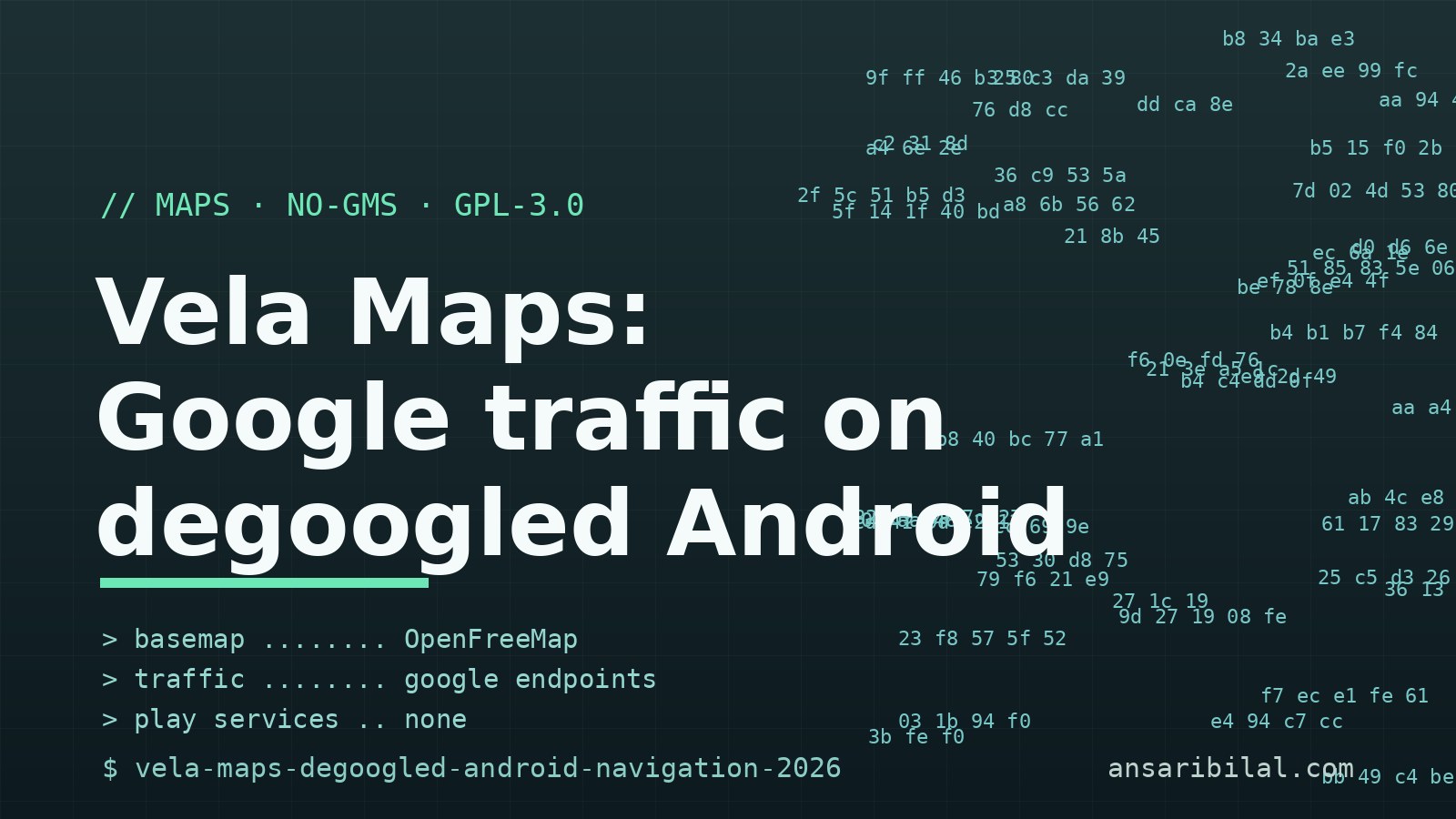
The project's own framing is the clearest one-line pitch in this series so far: what NewPipe is to YouTube, for Google Maps. The basemap comes from keyless OpenFreeMap vector tiles wearing Google's sampled color palette, so the visual comfort zone survives the migration. The things only Google does well — POI search quality, routing, traffic-aware ETAs — are fetched by the app itself from Google's public web endpoints, one device at a time, with no server operated by the developer.
That architecture is the whole privacy argument. There is no Vela account, no Vela server logging your queries, no intermediate party that could sell your movements. Your phone talks to the same endpoints the Google Maps website uses; what you give up is Google's app-level identification stack, not the network-level one. It is a trade, and the README does not pretend otherwise — this is the honest kind of privacy story.
What you actually get on screen
The feature list reads like a checklist of the reasons people go back to Google Maps. Turn-by-turn navigation with lane guidance, route shields and a speedometer. Directions with alternates, traffic described in plain words next to each option, and the familiar avoid-toll and avoid-highway toggles. Live transit departure boards with a tap-through stop list for every route. In-app light and dark themes decoupled from the OS setting.
All of it is built to run on GrapheneOS and other no-GMS ROMs — the targets that every mainstream navigation app fails on. For the degoogled community, which has spent years choosing between Organic Maps' offline excellence and a traffic-shaped hole, this is the missing shelf.
Install and trust story
Distribution is modern and unusually transparent. Obtainium tracks the weekly stable channel; flipping a setting moves you to nightlies. The project also runs its own F-Droid repository — add pimpinpumpkin.github.io/Vela/repo to any F-Droid client — and direct APK downloads sit on the releases page. Every APK from every channel is signed with the same key, and the README documents fingerprint verification rather than hand-waving it, which is exactly the trust posture sideloaders should demand.
Release health is real: v0.4.1065 shipped September 5, with a stream of builds through August, and the repository was pushed to on the day of writing. Created June 15, 2026, at 332 stars and climbing, this is one of the fastest-growing projects the series has covered.
The cat-and-mouse caveat, stated plainly
Here is the part that belongs in bold: Vela's cleverness is also its fragility. Scraping Google's endpoints is the same détente NewPipe has danced for a decade — Google can change response shapes, add challenges, or throttle patterns at any time, and each change becomes a scramble to restore service. The project's per-user, no-backend design softens the blast radius but does not eliminate the dependency.
The legal gray zone deserves one honest sentence too. Reading public endpoints is not the piracy-adjacent territory of patched APKs, but it is unsanctioned use of a competitor's data, and the project could receive a takedown request the way NewPipe has. None of this is a reason to skip Vela; it is a reason to keep a second navigation app installed. Readers of the Shizuku coverage already know this site's stance: understand what the tool depends on before it becomes load-bearing.
Who it is for, who should wait
Install it today if you run GrapheneOS, CalyxOS or any degoogled ROM and have been rationing your Maps usage through the browser. It also suits the privacy-conscious mainstream: if your threat model is "Google in my pocket all day" rather than "Google sees one HTTPS request per search", Vela removes the constant companion while keeping the useful data — the same calculus behind the tools in my privacy stack.
Wait if you need guaranteed uptime for a delivery job or daily commute-critical routing — carry a fallback, because v0.4 software on scraped endpoints has no uptime promises. And if you want the deepest dive, the repo's HOW-IT-WORKS.md is the best architecture write-up in this series since SwiftWave's.
Verdict
Vela Maps is the first credible answer to the question the degoogled community has asked for years: can we keep Google's data quality without Google's app stack? The design says yes, the release pace says the maintainer intends to win the cat-and-mouse, and the 332 stars say the audience is finding it. That is the exact profile this series exists to surface.
Next Buried Treasure: a project tracker younger than Vela, growing even faster, where AI agents sit on the board as teammates.
---
Not affiliated with the Vela Maps project. Facts verified from the GitHub repository, README, FDROID.md and releases on September 6, 2026. More open-source discoveries in the Buried Treasure series.