Tutorials
Agentty Puts a Whole Coding Agent in One 16 MB Binary
A MIT-licensed terminal coding agent written in C++26: no Node, no Python, millisecond startup, ten model providers, retrieval built in. Buried Treasure No9.
Last updated: September 6, 2026 · 7-minute read
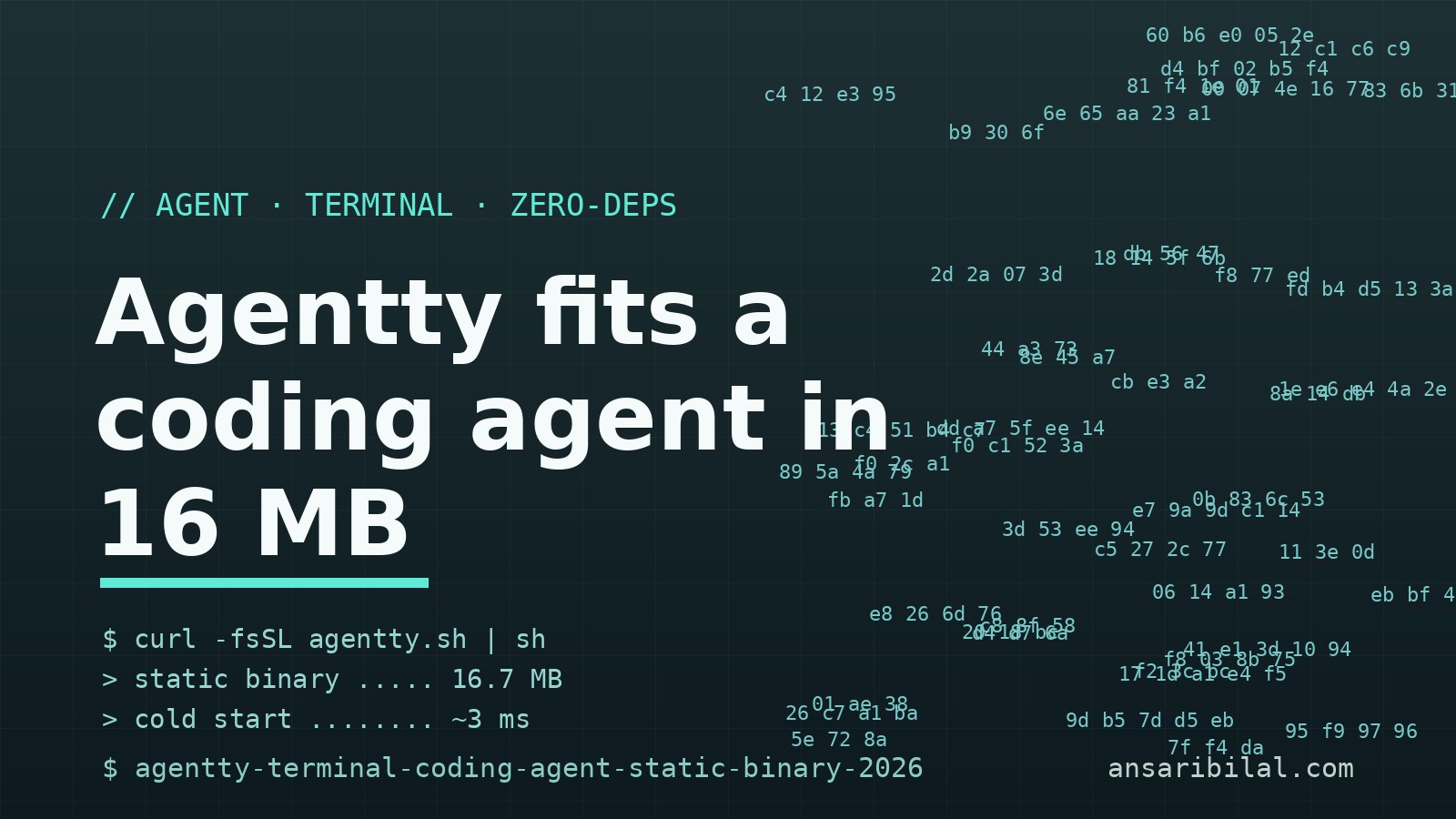
16.7 megabytes, zero runtime dependencies, and a cold start the README measures in milliseconds. That is the entire install story for Agentty — a terminal coding agent written in C++26 that positions itself as a drop-in Claude Code alternative while shipping the one thing its Node-based rivals cannot: a single static binary with nothing to install underneath it.
Buried Treasure №9, and a fit for the AI-tooling territory this site covers most. Every fact below comes from the repository, its README and its release history, verified September 6, 2026.
What the repo actually shows
The numbers first, because in this series the receipts come before the pitch. Agentty (GitHub: 1ay1/agentty) holds 604 stars, carries the MIT license, and was created April 17, 2026. It has been pushed to on the day this was written, and the release cadence is the aggressive kind: v0.4.0 landed August 24, then v0.5.0, v0.6.0, v0.7.0 and v0.8.0 followed by September 4 — five tagged releases in under two weeks.
The project's own description is blunt: a blazing-fast, open-source coding agent in your terminal, in C++26, one static binary, any model. The 0 open issues count reads as either immaculate maintenance or disabled bug intake — the issues tab is enabled, so early days and low exposure are the likelier explanation.
Why a static binary matters here
Every mainstream terminal agent in 2026 asks for a JavaScript runtime first. Claude Code, OpenCode, Gemma CLI-class tools — the install step is npm, and the update treadmill never really stops. Agentty deletes that layer. There is no Node, no Python, no nodemodules folder quietly eating a gigabyte; the README's install is a one-line curl into a shell script, with a .deb for Debian-family machines.
The startup claim matters less on paper than in the hand — a millisecond versus a two-second launch changes how often you actually reach for the tool. The honest caveat, and it applies to every entry in this series: I have not benchmarked the binary on my own machine. What the repository verifies is the packaging story — one file, no dependencies, releases for common platforms — and that story is real.
The retrieval angle is the serious part
The feature that separates Agentty from a fast terminal wrapper is built-in retrieval. Instead of dumping whole files into context, it runs a hybrid pipeline — BM25 keyword search plus dense embeddings with code-aware chunking, and a GraphRAG path — to fetch only the slices relevant to the current turn. The README claims context reductions of 80% or more versus whole-repo dumping on suitable tasks.
That claim deserves skepticism in the general case, but the design direction is correct and matches where the industry is converging: token budgets are the real constraint of agentic coding, and retrieval quality is becoming the differentiator. The semantic half is optional — BM25 works with zero setup, and dense embeddings switch on via configuration, which is the right default ordering for a tool people run on machines of wildly different specs.
Any model means it, including local
Provider coverage is unusually wide: sign in with a Claude Pro or Max subscription, or point the tool at OpenAI, Groq, OpenRouter, Cerebras, DeepSeek, xAI, Mistral, Gemini, Fireworks — or a fully local Ollama model. Switching happens live with a keybinding rather than a config edit, which turns model choice into a per-task decision instead of an installation decision.
Sandboxing is on by default for shell and build commands, and there is an air-gap mode that routes an entire session over SSH. The agent also runs inside Zed over ACP, which hints at where editor-agnostic agents are heading — the terminal is just one front-end for the same core.
Who should try it, who should wait
Try it if you live in the terminal, juggle multiple model providers, or work on a machine where Node-based toolchains are a tax — older laptops, ARM boards, locked-down corporate images. It also pairs naturally with the multi-agent workflow crowd: one cheap local model for retrieval-heavy grunt work, a flagship for the hard turns, switched per session.
Wait if you need battle-tested stability for revenue work today. This is v0.x software with one dominant contributor, and the bus factor is the real risk — brighter even than the feature set, at this stage, in a one-person C++ codebase. Watch the release cadence; it has been the healthiest signal this project has.
Verdict
Agentty is the clearest expression yet of where terminal agents go after the npm era: compiled, dependency-free, retrieval-first, provider-agnostic. The 604 stars undersell how interesting the architecture is; the five-releases-in-two-weeks pace says the architecture is not vapor. Star the repo, read the retrieval docs, and keep it installed next to your daily driver — that is exactly how the tools in this series earn their keep.
The next Buried Treasure leaves the terminal for your phone's home screen — and takes on the hardest data source in consumer software.
---
Not affiliated with the Agentty project. Facts verified from the GitHub repository, README and releases on September 6, 2026. More open-source discoveries in the Buried Treasure series.