Tutorials
usage Tracks Claude Code and Codex Quota in Your Menu Bar
A local-first tracker that reads Claude Code and Codex logs straight off disk — quota, burn rate and cost with zero API calls. Buried Treasure №6 digs in.
Last updated: September 14, 2026 · 7-minute read
Hitting a Claude Code quota wall at hour three of a refactor is a special kind of pain — the session dies, the context evaporates, and the restart tax comes out of your remaining budget. A project called usage attacks exactly that problem, and it does so with a constraint most dashboard tools skip entirely: it never calls an LLM API to tell you what you have left. 309 stars, AGPL-3.0, ten contributors, and a release cadence that hit v0.30.9 on September 5, 2026 — roughly three months from first commit to that version number.
Buried Treasure №6, and an easy call — this one sits dead center in this site's most-covered territory.
The trick: read the logs, not the API
Claude Code and Codex already write usage telemetry to log files on your machine. usage parses those files locally and renders the result as a macOS menu bar item or a Windows tray icon — color-coded from green to red, with a click opening session, weekly and per-project breakdowns. Because the numbers come from disk rather than from Anthropic or OpenAI endpoints, checking your quota costs nothing, adds no latency, and leaks nothing.
Two sources break the all-local rule, both with a paper trail. Antigravity quota comes from Google's official quota endpoint, authenticated with the sign-in the Antigravity CLI already stores on your machine — a metadata call that does not consume model quota. Grok CLI's weekly credit percentage is read from its own local debug log. Everything else, the README states plainly: log contents are never uploaded.
Install on macOS is one line:
Not on macOS, or just want the numbers? uvx usage-cli runs the terminal interface anywhere Python runs, Linux included.
What you actually get day to day
The headline number is 5-hour and weekly quota, but the details are where this earns permanent menu-bar real estate:
- Burn rate and cost, per session and per project, so "can I finish this task before the window resets" becomes answerable before you start.
- Context nudges — at 70 percent context fill, the status line suggests /clear or /compact before token waste happens.
- Prompt cache health — a hit-rate readout with a countdown to cache expiry, so you know whether finishing now reuses the cached context or re-sends it. Needs Claude Code 2.1.251 or newer; older versions simply omit the segment.
- Service status alerts — an orange-red banner when Claude or Codex status pages report degradation, which explains the quota shape that was not your fault.
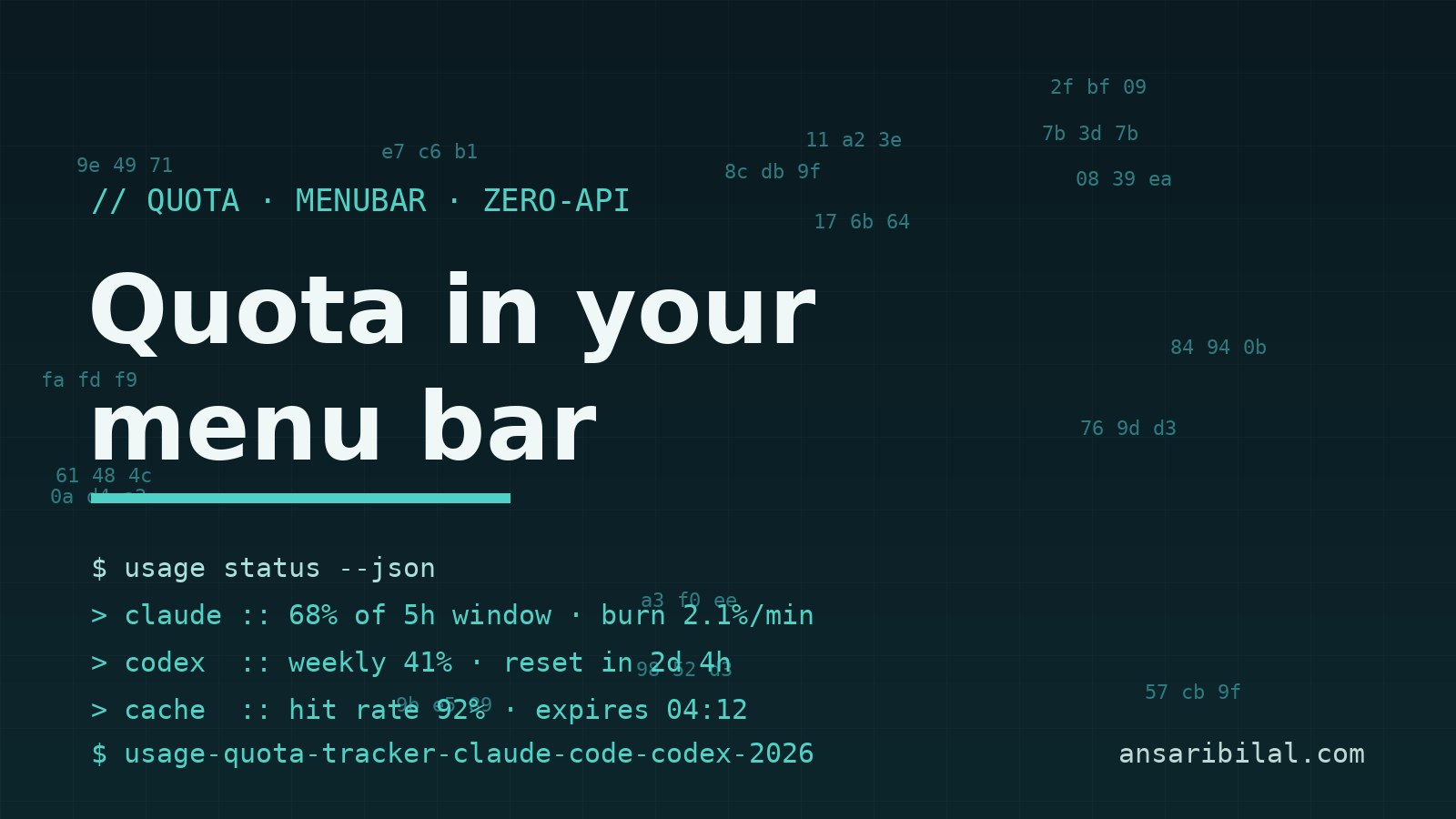
- usage status --json — the same local data handed to Starship, tmux, or your own scripts.
There is more — an opt-in "Progress Concierge" that hands your last session state to a fresh Claude Code run, a "Token Saver" toggle that asks for terser replies, HTML reports with a Year-in-Review view, and fourteen themes — but the core loop is the one above, and it holds up.
Where it falls short
Version 0.30.x means the project is young and proud of it — releases land fast, and the feature list grows faster than any changelog summary can pin down. Log parsing is the structural risk worth naming: the entire local-first trick depends on Claude Code and Codex log formats staying stable, and a format change upstream breaks the tracker until it is patched. The release history suggests the maintainer fixes such breaks quickly, but a window of wrong numbers after every major CLI update is a real cost. The "Token Saver" A/B figures in the README — late replies roughly 40 percent shorter — are the developer's own measurement, not an independent audit, and I have not tested the tool on my own machine; this piece is built from the repo's README, its release history, and the GitHub API metadata, all pulled September 6, 2026.
Also worth knowing: AGPL-3.0 licensing, Python 3.13 as the runtime floor, and Linux support limited to the terminal UI — the menu bar treatment is macOS, the tray treatment is Windows.
Who should skip it
If your Claude Code usage lives inside a company plan with hard spend caps and an admin dashboard, corporate tooling probably covers you. If you are on pay-as-you-go API billing rather than subscription quotas, the 5-hour-window framing matters less to you. And if you just want a weekly email summary, a cron job and the JSON endpoint get you there without a resident menu bar app. For everyone else running heavy agentic sessions — the workflow this whole site keeps optimizing — quota blindness is the tax usage removes.
Try it in five minutes
Right-click the app on first launch to pass Gatekeeper, click the menu bar icon, and your running Claude Code history paints itself. Two minutes of configuration — hide the tools you do not use, opt into notifications for limit hits — and the whole thing settles into being plumbing. The free-credits landscape makes it easy to juggle several AI subscriptions at once; this is the instrument panel that makes juggling them survivable.
TL;DR
- usage is an AGPL-3.0, local-first quota tracker for Claude Code, Codex, Antigravity and Grok CLI — 309 stars, v0.30.9 released September 5, 2026.
- Claude Code and Codex numbers come from local log files; checking quota never calls an LLM API or spends a token.
- Burn rate, per-project cost, context nudges, prompt-cache health and status-page alerts arrive as menu bar (macOS) or tray (Windows) surfaces; uvx usage-cli covers Linux.
- Main risk: log-format changes upstream can break parsing until patched; the project is young and iterates fast.
- Skip it if corporate dashboards or API billing already cover your needs.
---
Not affiliated with aqua5230, Anthropic, OpenAI, or Google. Sources: the usage GitHub repository, its README and release history, and GitHub API metadata pulled September 6, 2026.