Tutorials
Noodle Stores Every API Request as a Versioned YAML File
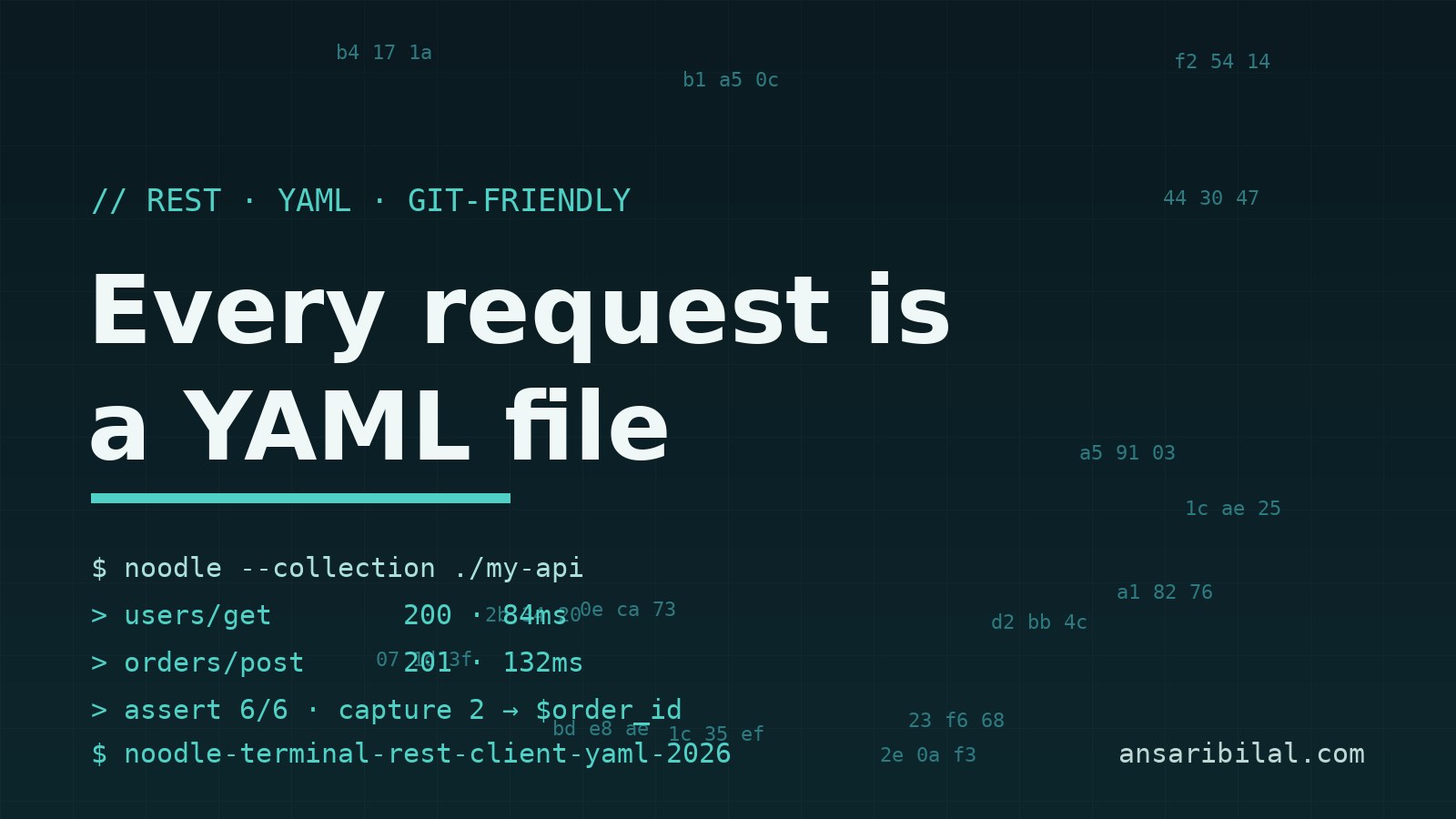
A keyboard-first REST client built around readable YAML request files — Git-reviewable, scriptable, and readable by the coding agents already editing your repo. Buried Treasure №7.
Last updated: September 15, 2026 · 6-minute read
301 stars, 6 forks, and a pitch that fits in one sentence: every API request you will ever make against a service, stored as a readable YAML file next to the code that depends on it. Noodle is a terminal REST client in the Postman-replacement category, but its file-first design puts it closer to the "what if curl had a review workflow" school of thinking — and in 2026, files that agents can read and edit are the whole game.
Buried Treasure №7 — the series that finds undercounted open-source tools and checks the receipts. This one: Apache-2.0, TypeScript, created June 24, 2026, latest release v0.8.4 on September 4, pushed to GitHub within a day of this writing, three contributors.
A request is a file, and the file is the product
Here is the entire mental model, from the repo's own docs:
Requests are YAML files in a collection folder. You create them from the CLI or edit them in any editor, review them in Git diffs like any other code, and open the collection in a keyboard-first TUI to send and inspect. The README's positioning is blunt about the intent: "Write, send, inspect, and automate HTTP requests from readable files without leaving your terminal."
The split of labor is the design's best trick. The YAML file is the shared, reviewable, durable artifact; the TUI is just one of its consumers. Bootstrap a collection in three commands:
Inside the TUI, one exchange shows everything — body, headers, cookies, status, timing, and a network timeline — without losing your keyboard context.
Assert, capture, and the automation story
Two tabs carry the weight beyond simple sending. Assert rows define response checks; Capture rows extract values from responses into variables for later requests. Both are structured rows with per-row checkboxes — flip a checkbox off and the declaration stays in the file but is skipped by manual sends, the collection Runner, and CLI runs alike. Jump mode binds v to Assert, c to Capture, t to Settings, keeping the whole loop on keys.
This is where the agent angle stops being buzzword salad. Because requests are plain files with a documented structure, a coding agent working in your repo can read the collection, add a request for the endpoint it just wrote, or update assertions when an API changes — the same way it already reads your tests. Noodle's own topic list on GitHub includes ai-agents and ai-skills, which tells you the maintainer sees the same convergence. Collections versioned beside code also mean an API change shows up in pull requests as a diff, not as a Slack message three days later.
Where it falls short
Version 0.8.x is pre-1.0 by any honest reading, with three contributors carrying the project — the classic bus-factor caveat, softened only by an active changelog. The YAML format is Noodle's own dialect; the ubiquitous .http convention used by JetBrains and VS Code REST Client, and Bruno's .bru format, are different dialects of the same idea, so migrating a large existing collection is work, not a copy. Docs live on noodlerest.dev, and they are good, but a project this young will have gaps where the README ends and experimentation begins. Method note, per house rules: I have not stress-tested Noodle against a real API fleet — this piece is built from the repository's README, its install docs, and GitHub metadata pulled September 6, 2026.
One more honest line: if your API work is two curl calls a month, this is a power tool you do not need. The target user ships against APIs weekly, reviews changes in Git, and hates context-switching to a GUI.
Try it in five minutes
Point it at any public API, add one request from the CLI, send it, and walk the response panels. If it clicks, the second step is committing the collection folder — that is the moment the Postman-export-shaped hole in your workflow becomes obvious. It slots naturally into the terminal-first toolkit this site keeps building out.
TL;DR
- Noodle is an Apache-2.0 terminal REST client — 301 stars, v0.8.4 released September 4, 2026, three contributors, moving fast since June.
- Every request is a readable YAML file: versioned in Git, reviewable in diffs, editable by humans and coding agents alike.
- The TUI handles sending and inspection; Assert and Capture rows add response checks and value extraction that the Runner and CLI respect.
- Caveats: pre-1.0, small team, and a YAML dialect that will not import your .http or Bruno collection without work.
- Skip it if your API usage is occasional; adopt it if requests belong in code review.
---
Not affiliated with wilfredinni, Postman, or JetBrains. Sources: the Noodle GitHub repository, noodlerest.dev documentation, and GitHub API metadata pulled September 6, 2026.