Insights
TypeScript 7 Is the Default Now (What GA Actually Changed)
TypeScript 7 went GA on July 8, 2026: npm's typescript package now ships the Go-native compiler. Microsoft's benchmarks, the catches, and the TS6 escape hatch.
Last updated: September 9, 2026 · 5-minute read
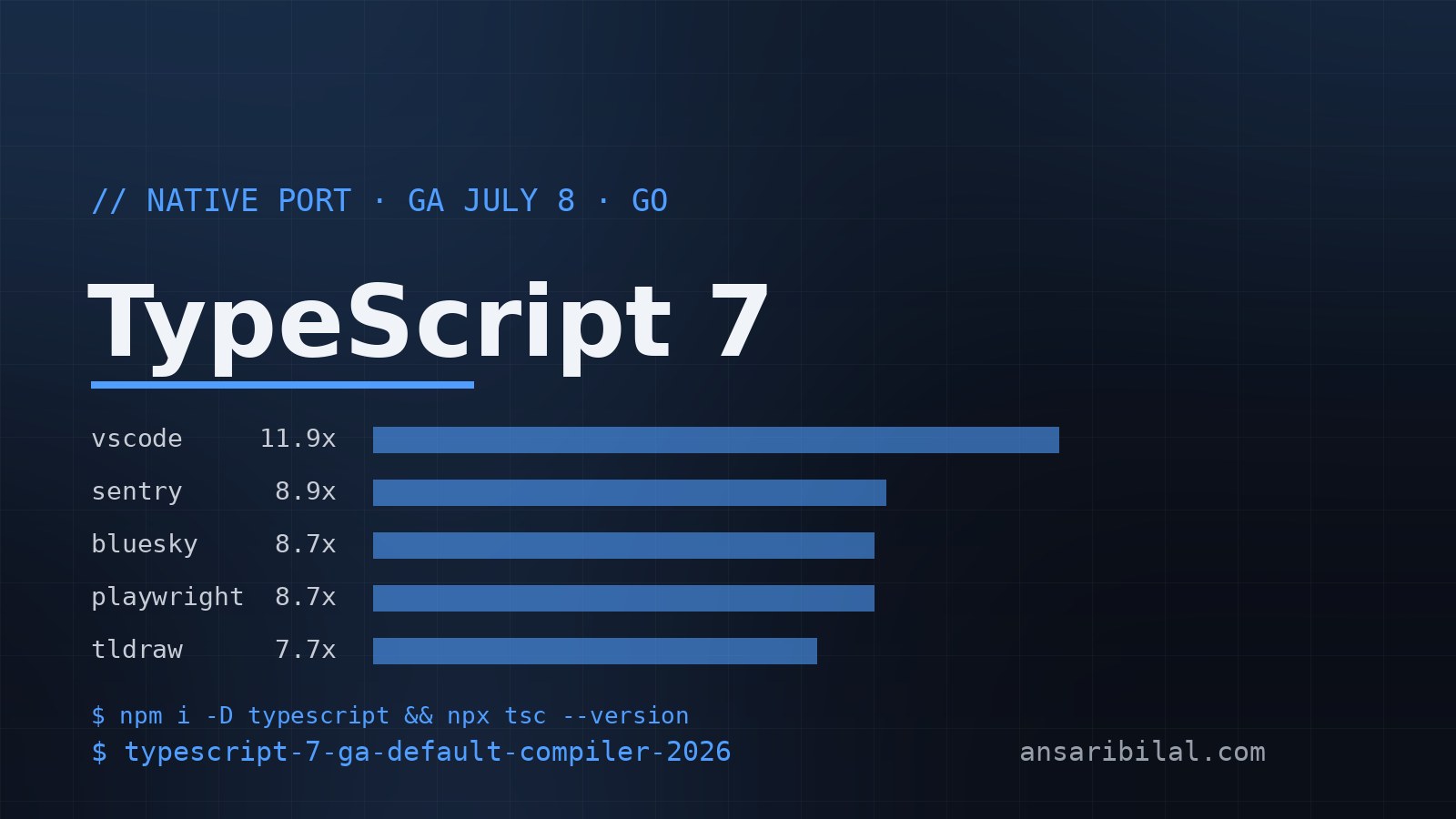
On July 8, 2026, TypeScript 7 reached general availability, and the preview-era framing died that day: installing typescript from npm now gets you the Go-based native compiler by default, not an opt-in experiment. Microsoft's published benchmarks claim builds between 8× and 12× faster — and two months in, the more useful question is not whether it is fast, but what an ordinary app developer actually has to change.
A disclosure before the numbers: my own repos have not been migrated as of this morning, so there is no hands-on war story here. Everything below is a verification pass over the official announcement, the GitHub release history, and the documented compatibility path — and every benchmark is labeled as whose number it is.
What shipped on July 8
TypeScript 7.0 is the native port: the compiler rewritten in Go, with shared-memory multithreading and a batch of new optimizations that Microsoft says typically yield speedups between 8× and 12× on full builds. The announcement came from Daniel Rosenwasser, the project's principal product manager, and the port is built in the open — the typescript-go repository sits at 26,208 stars as of this writing, Apache-2.0 licensed.
The default-package switch is the part that touches daily habits. npm install -D typescript now installs the native compiler and its new tsc binary. Editor support runs over the language server protocol, VS Code has a dedicated TypeScript 7 extension available today, and Visual Studio enables TS 7 automatically per workspace.
The current patch is v7.0.2, published August 20, 2026 — two months of quiet maintenance since the GA announcement. None of this arrived unannounced, either: the GitHub release history shows the JS-based transition line shipping through early 2026, with a TypeScript 6 beta in February, a release candidate in March, and two stable patches by mid-April. That line carried ecosystems through the gap while the native compiler matured, which is why a compatibility package exists at all. The port era did not start in July; it just became the default in July.
Microsoft's published benchmark numbers
Here is the full-build table exactly as the team published it — vendor benchmarks, not independent measurements, and the honest reading treats them as a compiler team's best case for its own compiler:
Memory tells a similar story on the same terms — aggregate memory over a build dropped 18% on the vscode codebase (5.2GB to 4.2GB), 26% on bluesky, and between 6% and 15% on the rest of the table. The figure I find most relevant to daily work is editor-facing: in the vscode codebase, opening a file with an error went from about 17.5 seconds to under 1.3 seconds before the first error appears.
Even discounted as self-reported numbers, the shape matters more than any single row. A type-check that finishes in seconds instead of minutes changes whether you bother running it — and for anyone who trained themselves to skip tsc because it was slow, that is a habit worth untraining.
What actually changes for app developers
For everyday application developers — people writing apps, not compiler tooling — three things change and one does not. The changes: typescript now resolves to the native compiler, editor checks and full builds get dramatically faster on large codebases, and CI type-check steps should shrink accordingly. The non-change: the TypeScript language you write stays the TypeScript language you know, and nothing about your app's source code is owed to the port.
There is also a second-order effect worth naming. Fast feedback compounds — shorter checks get run more often, more frequent checks catch type errors closer to where they were written, and agent-driven coding loops depend on exactly this kind of speed. The teams most likely to feel the difference are the ones whose edit-check cycle used to be measured in coffee breaks.
The catch list, two months in
Three catches are documented, and each one changes a decision. First, no compiler API: TypeScript 7.0 ships without one, and the team says it expects TypeScript 7.1 to ship a new and different API — expected, not scheduled, so do not build tooling plans around a date.
Second, behavior differences exist. The announcement documents a Differences section, and JavaScript plus JSDoc support in particular was revisited — which in changelog language means changed, not dropped. Nobody credible claims zero breaking changes, so do not plan around that assumption.
Third, the ecosystem is still catching up. Tools that reach into the compiler — typescript-eslint being the most common — need the side-by-side path until their TS 7 support lands. The honest move is checking each tool's TS 7 status before flipping your lockfile, not after the flip breaks CI.
The escape hatch when you need TS 6
For the transition, Microsoft publishes @typescript/typescript6, a compatibility package that ships a tsc6 executable and re-exports the TypeScript 6.0 API — the JS-based line that carried the ecosystem between 5.x and the native port. Both compilers can sit side by side in one repo:
That combination lets CI run the new compiler while typescript-eslint or any API-dependent tool keeps its known-good path. When 7.1 lands with its new API, the tooling migration story starts over — which is exactly why the compatibility package exists rather than a cliff.
TL;DR
- TypeScript 7 went GA on July 8, 2026 and is now the default typescript package on npm — the preview era is over.
- The 8×–12× build speedups are Microsoft's published benchmarks; vscode going 125.7s→10.6s is the headline row.
- No compiler API until 7.1, and that API will be different — plan tooling bets accordingly.
- @typescript/typescript6 with its tsc6 binary is the documented side-by-side escape hatch.
- Behavior differences exist (JS/JSDoc support was revisited) — check each tool's TS 7 support before flipping the lockfile.
Keep reading
- TypeScript tricks I use in every React project
- The Tauri + React stack this site runs on
- Vibe coding production checklist — where build speed pays off
- Developer Workflow — the hub for tooling posts
---
Not affiliated with Microsoft or the TypeScript project. Sources: Announcing TypeScript 7.0 on the Microsoft developer blog and the TypeScript GitHub releases, verified September 9, 2026.