Builds
PodXplain: Turn a Script Into a Multi-Voice Podcast on CPU (Maker Post From the Live Space)
PodXplain is a free Hugging Face Space that turns a written script into a two-voice podcast with Kokoro TTS — speaker detection, chunking, and MP3 out.
Last updated: November 21, 2026 · 6-minute read
Paste a script, get a podcast. PodXplain is my Hugging Face Space that turns written dialogue or narration into a multi-voice audio episode — a host and a guest, speaking in turn — using the Kokoro-82M text-to-speech model on a free CPU instance. No GPU, no API key, no cost per episode. This post documents what the Space actually does, from its own source: the direction matters, because the tool is a script-to-podcast generator, not a podcast summariser.
The build exists for a specific workflow: explanations read better as conversations. A two-voice script — one voice asking, one answering — holds attention in audio the way a wall of narration does not. Writing the dialogue is the creative work; PodXplain exists so the production step after it is one paste and one click.
What the Space Actually Does
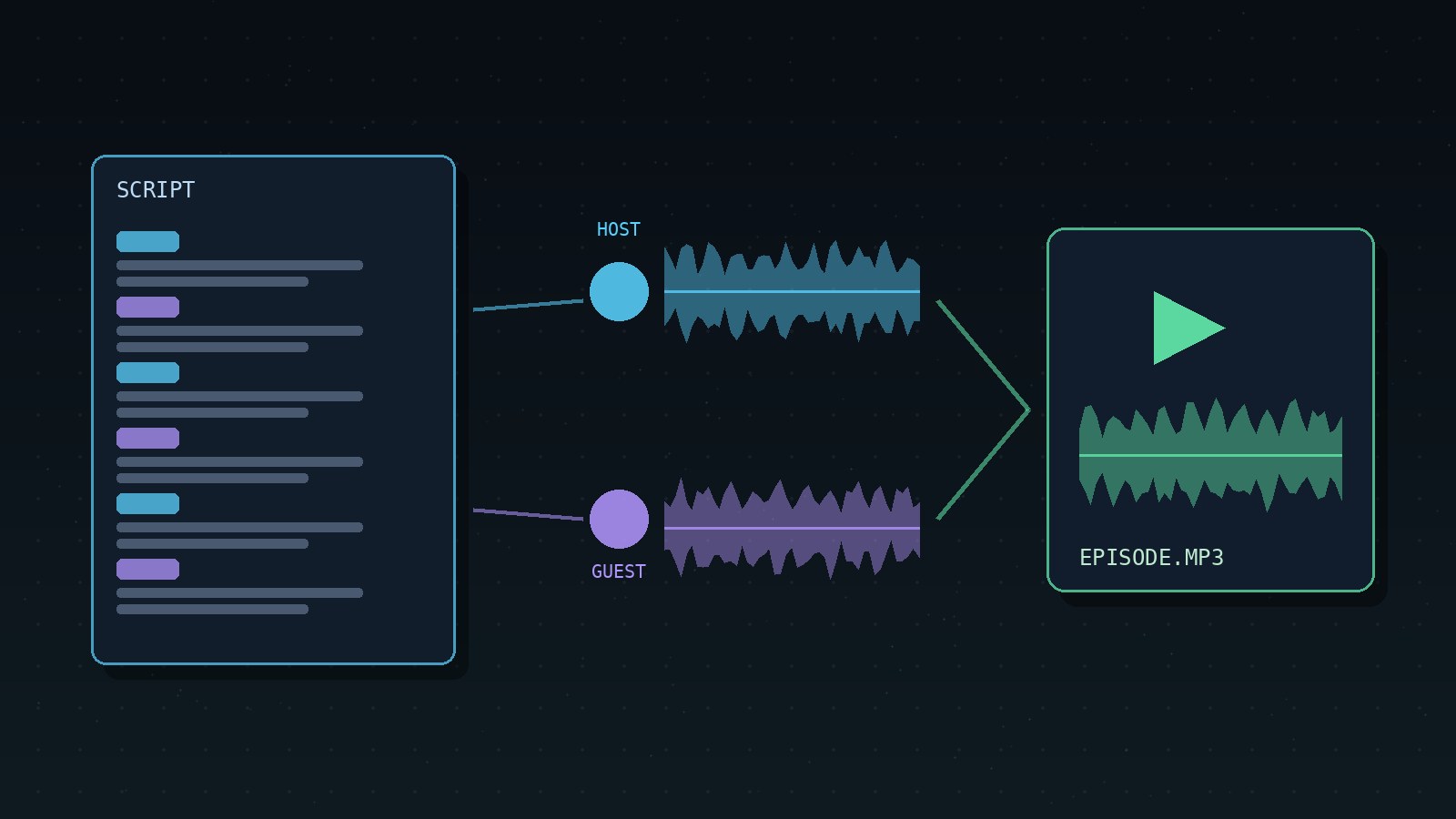
The pipeline, exactly as the public source in the Space lays it out:
1. Input — a text script, up to 50,000 characters (the limit is a constant in app.py, not a marketing number) 2. Speaker detection — the script is split into (speaker, text) segments by one of three modes in speakerdetection.py 3. Chunking — textprocessing.py cuts segments into pieces of at most 420 characters, preferring sentence boundaries, then clause boundaries, so Kokoro never receives a wall of text at once 4. Synthesis — ttsengine.py runs each chunk through Kokoro-82M at 24 kHz, with the selected voice per speaker, and stitches the audio with short silences (400 ms between speakers by default) 5. Output — one MP3 file (WAV as fallback), with a unique filename per user so concurrent visitors do not overwrite each other
The three speaker modes are the design centre:
Stage directions in brackets are dropped rather than spoken. Adjacent segments from the same speaker are merged before synthesis, which keeps the chunk count — and therefore the CPU time — down.
The Voice Cast
Kokoro-82M ships the voices; the Space curates eight of them into podcast roles, with two selectable per episode — a host voice and a guest voice:
Controls are deliberately few: the two voices, a speed slider (the engine's estimate maths works off the chosen rate), a pause control up to 1,000 ms between speakers, and the output format. The app even estimates the generation window before you commit — roughly 2.5 to 5 seconds of CPU per chunk at speed 1.0, per the status function in the source. On a free CPU instance, that estimate is the difference between a tool and a trap: a full 50,000-character script is a long wait, and the README's own advice is to generate long scripts in chapters.
TL;DR
- PodXplain: a free Gradio Space — script in, two-voice podcast audio out, Kokoro-82M doing the speaking on CPU
- Input up to 50,000 characters; three speaker-detection modes (dialogue, paragraph, auto)
- Eight curated voices in host/guest roles; speed and pause controls; MP3 output with WAV fallback
- The full source is public inside the Space: app.py plus speaker detection, text processing, and TTS engine modules
- It is text-to-podcast, not podcast-to-text: the writing is yours, the voices are the machine's
- English is the best-supported input, and the README states plainly that this is not voice cloning
What Is Visible, and What Is Not
Because this is a maker post, the honesty rules apply to my own project first.
Visible and verifiable: everything above comes from the Space's public files — app.py (386 lines), the three pipeline modules, requirements.txt (kokoro, pydub, transformers, scipy, numpy, soundfile, phonemizer), a test module, and an example dialogue. The Space metadata lists Gradio 5.24.0 on Python 3.10, an MIT licence, and the Kokoro-82M model. Anyone can read the same source and check every claim made here.
Not visible: usage. Hugging Face shows the Space's public like count, which stands at 0, and publishes no visitor or generation analytics to me either. So this post claims no users, no episodes generated, no audience — because there is no number I can stand behind. The Space was asleep on its free CPU tier when checked on November 7, 2026, which is what free Spaces do between visits; it wakes on demand, slowly.
Where It Falls Short
- CPU is the ceiling. Kokoro is fast for a TTS model, but a free shared CPU instance is still a free shared CPU instance. Long scripts queue behind the chunk estimate, and the chapter-by-chapter workflow is a workaround, not a solution. A GPU tier or a local install removes the wait; the Space as published does not.
- Two voices is a cast limit, not a cast. Host and guest cover explainers and interviews. A script with four characters gets squeezed into two voices by the detection modes, and the result sounds like what it is.
- Detection is pattern-matching, not understanding. The name-prefix and paragraph heuristics are predictable, which is their virtue, and brittle, which is their cost: an unmarked script with rapid speaker changes will be voiced wrong, in order, confidently.
- English-first. The README says English is the best-supported input; Kokoro's phonemizer pipeline (espeak-ng under the hood) is doing real work, and other languages are not the tested path here.
- Sleeping is the free tier's tax. First visit after idle time means a cold start. For a tool whose entire pitch is "paste and click," the wait before the click is the worst part of the experience.
The Verdict
PodXplain does one job with no moving parts to pay for: a written explainer script becomes a listenable two-voice episode, free, in a browser, with the source open for anyone to audit or fork. It will not replace a studio, a cast, or a GPU rig — it replaces the blank-page moment between "I wrote the dialogue" and "I can hear it."
For the script-first workflow it gets used in — draft the conversation, hear it, fix the lines that only fail out loud — that is enough tool. The related on-device angle is in the MomoTTS post, and the rest of the builds are on the projects page and in the blog archive.
---
Sources: PodXplain on Hugging Face Spaces — the Space's README, app.py, speakerdetection.py, textprocessing.py, ttsengine.py, and requirements.txt, read in full on November 7, 2026; Kokoro-82M model card.