Insights
Caveman: The Skill That Makes Claude Answer in Caveman-Speak to Cut Tokens (118K Stars, the 65% Claim Checked)
Caveman's 65% token claim, checked against its own benchmark: what was actually measured, what the project's honest-numbers page admits, and when it loses.
Last updated: November 19, 2026 · 7-minute read
118,098 stars, and a number that launched them: caveman-style answers cut output tokens by 65%. Caveman is the skill that makes your coding agent answer in stripped, telegraphic prose — articles dropped, fragments welcome, code untouched. Its own documentation now contains a page titled Honest Numbers, and that page says the quiet part: the 65% figure came from a fixed ratio the project's stats tool once applied to reports, without a committed, reviewed measurement behind it. Current reports ignore those old estimates entirely. So what does Caveman actually save? The repo, to its credit, publishes enough to answer that properly.
First, the licence, because the roundups get it wrong: Caveman is Apache-2.0. The LICENSE file in the repo is the Apache text, the README badge says Apache-2.0, and the GitHub API agrees. Coverage calling it MIT is copying an error.
What Caveman Is Now
The viral version was a single skill file with one trick. The current release line — the npm package is at 4.1.0 — is six components the project calls rocks: the response voice, an input compressor that shrinks logs, JSON and test output before the model reads them, a model-and-effort picker named Auto, a code-mode runner, waste diagnostics, and a web-page compressor. This piece judges the famous one, the voice, because that is where the 65% claim lives.
The voice is more disciplined than the meme suggests. Its rules, from the README:
- Answer first, in a fixed shape — thing, action, reason, next step — with no greeting and no recap
- One idea per sentence, built on ASD-STE100, the controlled English used in aircraft maintenance manuals: short sentences, active voice, one term per thing
- Meaning-bearing words are protected: negations, numbers, and units never get compressed away
- Code, commands, paths, and error messages pass through verbatim, character for character
- Security warnings, irreversible actions, and confused users get full sentences — then the grunt resumes
- Your own prompts are never rewritten, because the research the project cites found that caveman-style prompts make answers worse
The worked example in the README: a 63-token explanation of a React re-render becomes 20 tokens at the default level, 14 at /ultracave, 13 at /megacave, counted with tiktoken's o200k encoding. One cherry-picked answer at 68% down is where numbers like the famous one come from. Benchmarks are where they go to be averaged.
TL;DR
- The 65% figure was an assumed ratio in Caveman's own stats tooling, applied without a committed measurement — the project's Honest Numbers page says so, and current tooling ignores it
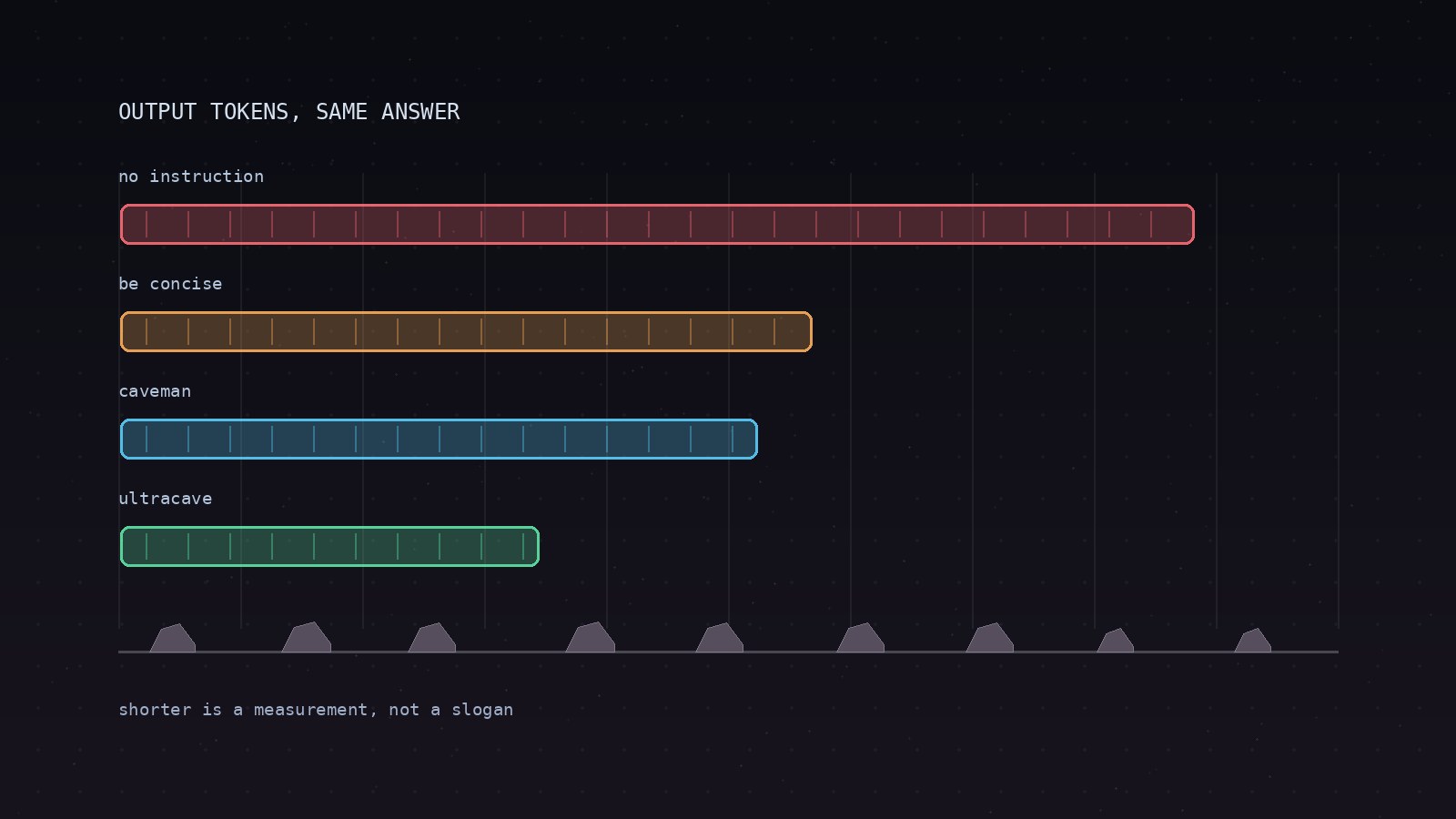
- Caveman's committed benchmark, 10 dev questions on an Opus model: 6,983 output tokens with no instruction, 4,119 with the skill — about 41% below default, and only about 5% below a plain "answer concisely" control at 4,334
- JetBrains ran the strongest outside test: 86 real coding tasks, paired A/B — 8.5% fewer output tokens, no measurable quality loss
- Output is a small slice of an agent bill; input, context, and cache reads dominate, and the skill's rules themselves add roughly 1,160 input tokens
- The licence is Apache-2.0, not MIT as widely reported — and the project's own rule of thumb is the right one: A/B your provider-billed totals, and turn it off if your total rises
The 65% Claim, Checked
The trail is short and the project itself maintains it. In docs/HONEST-NUMBERS.md, under a section about its stats reports, the repo states that earlier stats releases applied a fixed 65% output ratio without a committed reviewed result, that current reports ignore those historical estimate fields, and that the statusline no longer displays the numeric savings figure those estimates produced.
Read that plainly: the most-quoted number in Caveman's story was never the output of a benchmark. It was a constant in a reporting tool — an assumption that hardened into a headline as it travelled. The repository deserves credit for documenting the correction in its own tree; the correction travels slower than the claim did, which is exactly why pieces like this one exist.
What Its Own Benchmark Measured
The committed eval is smaller and more honest than the legend. Ten developer questions, run on claude-opus-5-5, output counted with tiktoken:
Against a verbose default, the default level cuts output by about 41% — real, and short of 65. Against the baseline that matters, a five-word instruction to be concise, the project's own summary in Honest Numbers puts the median gain at 3% for /caveman and 35% for /ultracave. The caveats are also the project's: a single run of 10 questions, output length only, measured on the 3.1.0 rules and not re-run since the rules changed, with the rules themselves costing about 1,160 tokens of input per injection.
Outside measurements land in the same neighbourhood, and the project links them itself:
- JetBrains ran 86 real coding tasks as a paired A/B: 8.5% fewer output tokens, and no measurable quality loss (p = 0.82). Agent sessions are mostly code and tool calls, which the voice leaves untouched — the project's own explanation for why the effect shrinks in real work
- LemonCrow's larger run — 300 runs per arm — measured billed output down 44.1%, and total cost up 0.06%. Output shrank by nearly half; the bill did not move, because the initial cached context grew by 1,532 tokens per run
- Elastic's Elasticsearch Labs remake reported 63.6% fewer response tokens across eight live MCP scenarios, in their own setup, on response-style output where compression has the most to bite on
- An analysis the project quotes across 662 Claude Code sessions found output was 0.3% of all tokens, and the skill's net effect on the bill sat within ±0.2%
What the Compression Costs
Shorter is not free, and the repo is unusually frank about the exchange rates:
- It can be net-negative, in its own issue tracker. One Cursor A/B the project cites showed 4.3 million tokens with Caveman against 1 million without, at twice the wall-clock time — not reproducible enough to prove a rate, but enough for the docs to warn that rule re-injection and retries can overwhelm output savings. A user measuring terse coding Q&A found the fixed rule overhead exceeded the output saved.
- Per-request billing makes it pointless. On GitHub Copilot-style pricing, a shorter answer is the same request. The docs say so directly: output compression cannot lower a bill that is not metered by output.
- Clarity is the currency. Stripping articles and connectives is safe for a status line and riskier for an explanation a junior developer must learn from — nuance, hedging, and causal glue are exactly what telegraphic style deletes. The voice protects negations and numbers by rule, which covers correctness; it cannot protect tone, teaching, or the sentence a confused reader needed spelt out. The project knows this: its own rules switch back to full sentences for security warnings and confused users.
- Quality equivalence is unproven — by the project's own standard. A fidelity eval exists, with fixed cases and checks that numbers, negations, and safety wording survive. No reviewed fidelity snapshot is committed, so Honest Numbers publishes no quality claim. Token counts measure length. They do not prove the shorter answer was as good, and the repo refuses to pretend otherwise.
The Verdict
Caveman is two things at once: a genuinely well-engineered style system with disciplined rules and an unusually honest paper trail, and the source of a viral statistic its own maintainers have walked back. Both things can be true, and on this site the second one gets printed next to the first.
Use it where its own evidence says it wins: chatty, prose-heavy agent output, metered by output tokens, in sessions long enough for trimmed answers to outrun the roughly 1,160-token cost of the rules. Skip it for per-request billing, for terse coding exchanges, and for any answer a human is supposed to learn from rather than merely receive. Measure the way the project itself instructs — same task, both ways, provider-billed totals — and keep it only if your total goes down.
That a 118,098-star project maintains a page titled Honest Numbers, listing the workloads where it loses, is the real story here. More projects should ship their corrections with the same prominence as their claims. The rest of the skills wave is in the MotionSites builder post and the blog archive.
---
Not affiliated with Caveman or Julius Brussee. Sources: Caveman GitHub repository, its Honest Numbers page, its evals, JetBrains A/B write-up.