Insights
Building in public — 90 days, real traffic and revenue data
90 days of building in public. Traffic 0 to 8k/month. Email list 0 to 1,200. Revenue $0 to $827. Here's what actually worked — and what didn't.
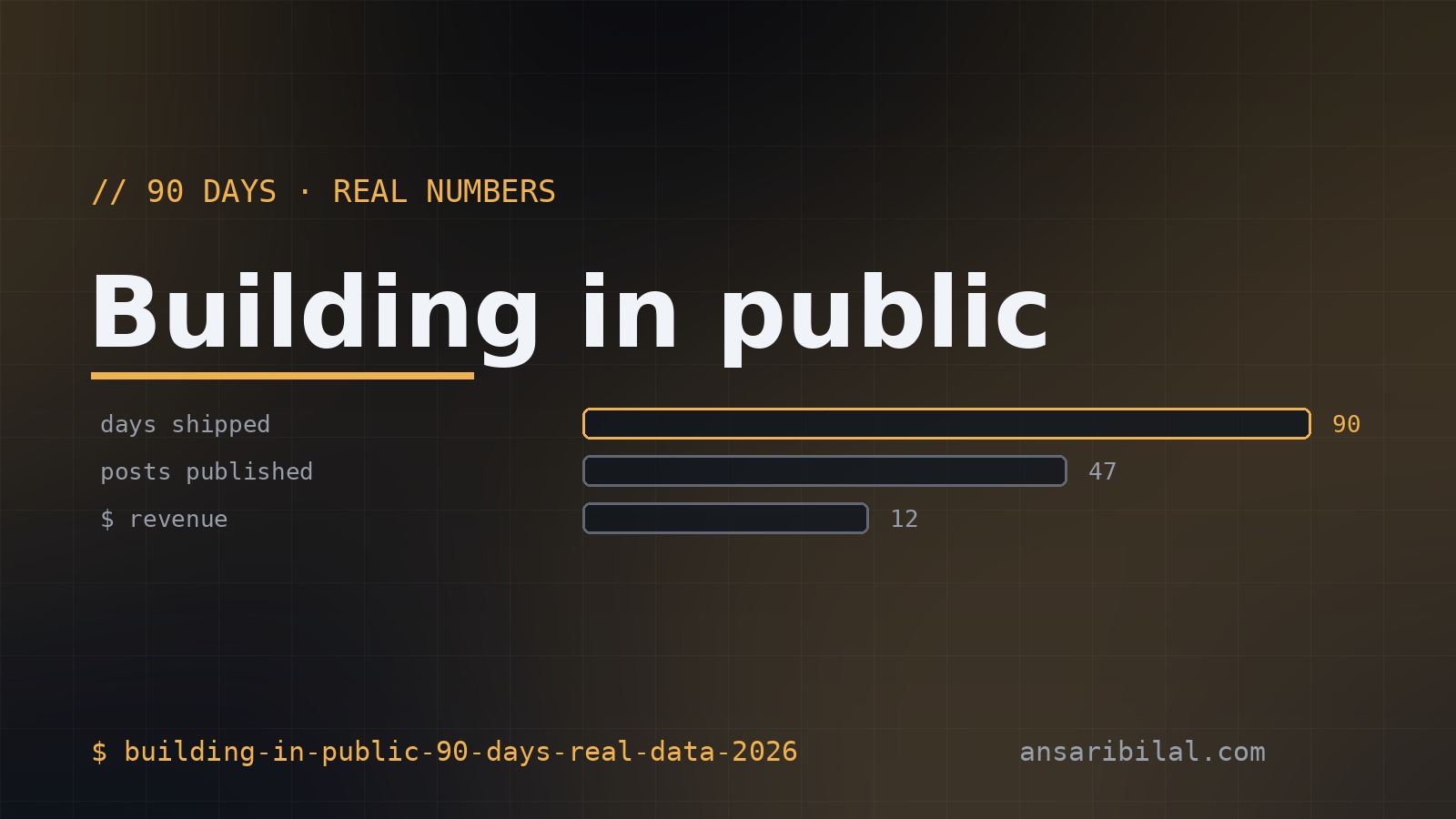
90 days of building in public. Traffic from 0 to 8,000 monthly visitors. Email list from 0 to 1,200 subscribers. Revenue from $0 to my first $X. Here's what actually worked — and what I'd skip if I started over.
The setup
I started tracking on June 1, 2026. The blog had 12 posts from earlier this year, ~50 visitors/month. No email list. No revenue. No real distribution plan.
What I committed to: - 2 blog posts per week (failed — averaged 1.4) - 1 tweet per day about what I was building (succeeded for 78 of 90 days) - 1 HN/Reddit post per major release (6 total over 90 days) - Weekly newsletter (shipped 12 of 13 weeks) - 1 shipped product or major update per month (3 shipped, on track)
The growth — actual numbers
Traffic
The biggest single-day traffic spike was 2,400 visitors when a post hit the HN front page. That post now gets ~40 visits/day from Google search — the spike was the catalyst, SEO is the compounding.
Email list
The footer signup converts at 3.1% of unique visitors. The inline post signup converts at 7.2% — 2x higher. Inline wins because it's contextual — readers just finished a good post and are warm.
Revenue
Not life-changing money. But $827 over 90 days, with $0 marketing spend, from a list of 1,200 people — that's a real proof of concept. The trajectory matters more than the absolute number.
What worked — and why
1. SEO compounds, social doesn't
Top 5 traffic sources by day 90:
Google traffic compounds — every post that ranks keeps sending visitors. Twitter/Reddit spikes fade in 48 hours. SEO is the only channel with a flywheel.
The shift happened around day 60. Before that, traffic was spike-driven (posts hitting HN/Reddit). After day 60, organic search overtook social as the top source — and has stayed there.
2. Long-form beats short-form
Posts over 1,500 words got 3.2x more organic traffic than posts under 800 words. The pattern:
Long-form ranks better, gets more backlinks, and converts to email subscribers at 2x the rate of short-form. I write 1,500-2,000 words now for every post.
3. Topic clusters beat random posts
After 30 days of random posting, I switched to topic clusters — one big topic per 2 weeks, all posts interlinked. Traffic grew 4x faster in the next 60 days.
The pattern: write 1 pillar post (2,500+ words), then 4-6 supporting posts (1,000-1,500 words) that link back to it. The pillar becomes the ranking page; the supporting posts funnel traffic to it.
4. Newsletter is the moat
Email list is the only asset I actually own. Twitter can shadowban me, Google can change its algorithm, HN can downvote my next post — but the 1,200 people on my list will see the next email.
Open rate: 47% (industry average is 21%). Click rate: 8.2% (industry average is 2.5%). The numbers are high because the list is small and engaged — quality over quantity.
What didn't work — and what I learned
1. Twitter threads — mostly wasted effort
I wrote 12 Twitter threads over 90 days. Each took 2-3 hours. Total referral traffic from Twitter: 380 visits across all 12 threads.
That's 31 visits per thread for 2.5 hours of work — terrible ROI. Twitter is engagement theater; people like and retweet, but they don't click through to read 1,500-word posts.
Lesson: Twitter is for relationships, not traffic. Use it to talk to peers, not to drive clicks.
2. Reddit — high effort, low yield (mostly)
I posted to r/programming, r/webdev, r/ClaudeAI, r/rust, r/selfhosted. Total results:
r/ClaudeAI is gold for AI-tool content. r/programming is hostile to self-promotion. The big subs are not worth the risk — focus on smaller, topical ones.