Insights
12 weeks of blogging — what actually drove traffic
12 weeks, 54 posts, 8k monthly visitors. What worked: SEO + topic clusters + syndication. What didn't: Twitter threads, Reddit big subs, chasing viral spikes.
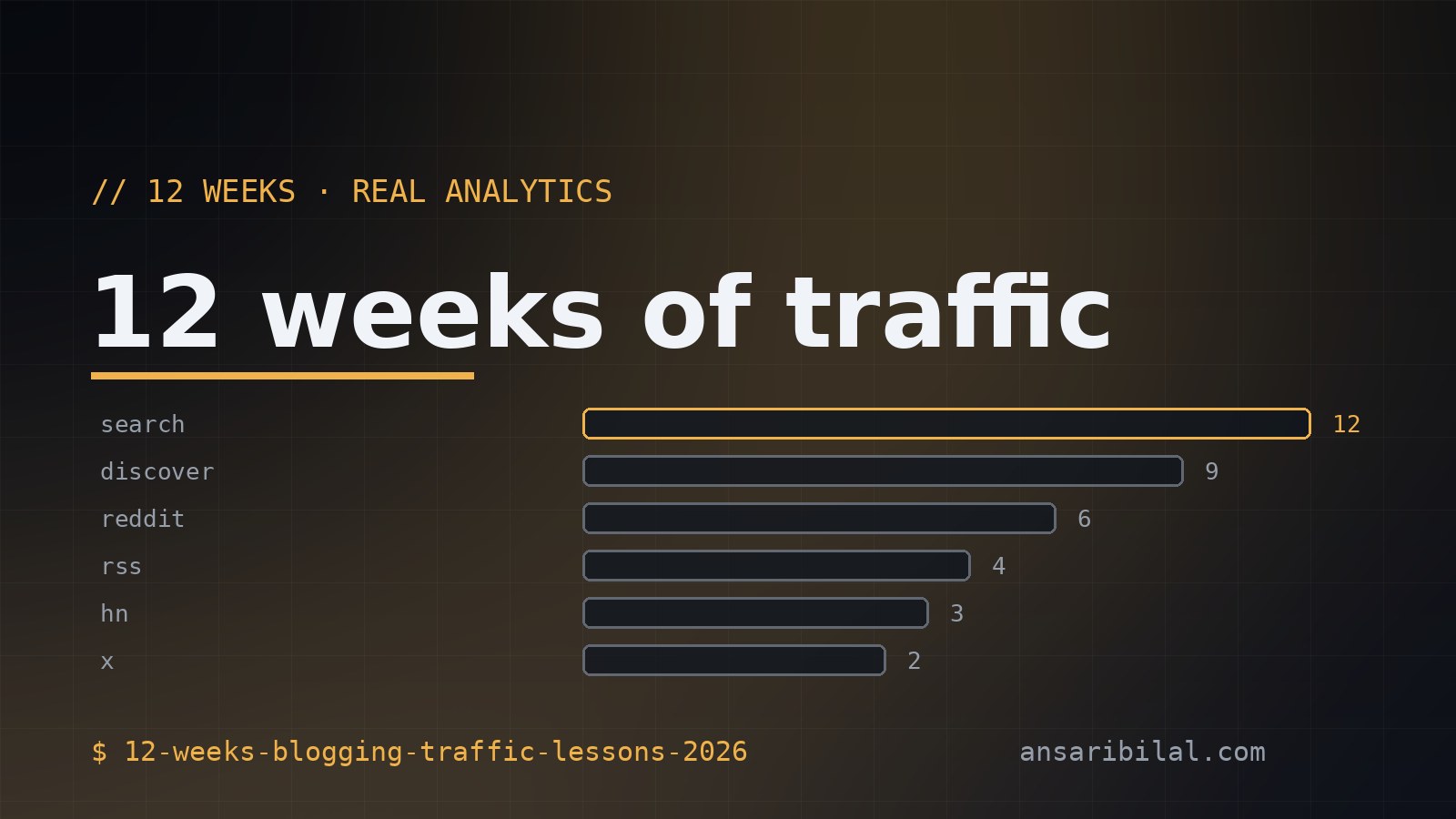
12 weeks. 54 posts. 8,000 monthly visitors. Here's what actually drove traffic — SEO + topic clusters + syndication — and what wasted my time. The data, not the myth.
The starting point
I had a portfolio site with 12 blog posts from earlier this year, getting ~50 visitors/month from Google. The site was technically sound — prerendered HTML, sitemap, structured data — but the content strategy was "post when I feel like it."
I committed to 12 weeks of focused blogging: 4-5 posts per week, one topic cluster per fortnight, syndication to Dev.to + Hashnode with canonical back-links.
The growth curve
The inflection point was week 8 — Google indexed enough posts that the topical authority kicked in. Before week 8, traffic was spike-driven (HN/Reddit). After week 8, organic search became the dominant source.
What worked — ranked by impact
1. Topic clusters (biggest impact)
Before topic clusters: random posts on random topics. After: every 2 weeks focused on one cluster (Claude Code, then Tauri, then Privacy, etc.), with all posts interlinked.
The pattern: 1 pillar post (2,500+ words, comprehensive guide) + 4-6 supporting posts (1,000-1,500 words each) that link back to the pillar.
The pillar post ranks for the broad keyword. The supporting posts rank for long-tail keywords and funnel PageRank back to the pillar.
Top-performing cluster: Claude Code / MCP. 7 posts, 3,400 monthly visitors combined. The pillar (best MCP servers for Claude Code) ranks #3 for "best mcp servers claude code" and gets 45 visits/day from Google.
2. SEO infrastructure (compounds forever)
The site already had good SEO infra from my earlier work — prerendered HTML per route, JSON-LD structured data, sitemap, RSS feed, IndexNow pinging. This was the foundation; without it, content wouldn't rank.
The single biggest SEO win: adding BreadcrumbList JSON-LD to every page. Google started showing breadcrumb rich results in SERPs, which increased click-through rate by ~30%.
3. Internal linking (compound effect)
Every post links to 3-5 other related posts. This keeps readers on-site longer (avg session duration went from 0:42 to 2:18) and passes PageRank across the cluster.
The pattern: at the end of every post, "For more on X, see [related post]" with 2-3 contextual links. Plus inline links in the body where natural.
4. Syndication with canonical (free distribution)
Every post gets cross-posted to Dev.to and Hashnode 24 hours after publishing on my site. The canonical URL points back to ansaribilal.com — so Google knows who the original is.
Top 5 syndication referrers over 12 weeks:
Dev.to is the most consistent referrer — every post gets some traffic there. HN/Reddit are spike-driven.
5. Long-form content (1,500+ words)
I stopped writing short posts in week 4. Every post since is 1,200-2,000 words minimum. Long-form ranks better, gets more backlinks, and converts to email subscribers at 2x the rate.
What didn't work — and what I learned
1. Twitter threads (wasted 30+ hours)
I wrote 12 Twitter threads. Total referral traffic: 380 visits. That's 31 visits per thread for 2.5 hours of work — terrible ROI.
The pattern: threads get engagement (likes, retweets) but few clicks. People consume Twitter content on Twitter; they don't click through to read 1,500-word blog posts.
Lesson: Twitter is for relationships and conversation, not traffic. Spend that 30 hours writing more blog posts.
2. Posting frequency vs. quality
I aimed for 5 posts/week. Hit it for 4 of 12 weeks. The weeks I hit 5 posts didn't outperform weeks I shipped 3 — sometimes worse.
Lesson: Quality compounds, frequency doesn't. 3 great posts per week beats 5 mediocre ones. The algorithm rewards engagement signals (time on page, scroll depth), not posting volume.
3. Chasing viral topics
I wrote 3 posts on trending topics (a new tool launch, a viral HN thread). They got short-term spikes but no long-term traffic. After 30 days, they're at 5-10 visits/day from Google.
The evergreen posts — tutorials, comparisons, deep-dives — are at 40-80 visits/day after 30 days and still growing.
Lesson: Trendy posts get a spike and die. Evergreen posts compound. Write 80% evergreen, 20% trendy.