Insights
OpenAI's GPT-6 Astra Is Here (What the Benchmarks Actually Say)
GPT-6 Astra launched with AGI-era rhetoric and huge scores. The pricing, the rollout, and the asterisks behind 98.6% on ARC-AGI-3 are the real story.
Last updated: September 7, 2026 · 7-minute read
OpenAI trained GPT-6 Astra on more than 100,000 GPUs at its Stargate site in Texas — the largest training run the company has ever done — and priced it at $10 per million input tokens, 2.5 times what its previous flagship costs right now. Those two facts explain the launch better than the "AGI era" headlines do: this is a model built expensively and sold expensively, and the benchmarks that justify the price all come with footnotes worth reading.
What actually launched on Thursday
Astra went live on September 3, 2026, and the lineup is deliberately simple: Astra, plus an Astra Pro tier for Pro, Business, and Enterprise users. There are no Luna/Terra/Sol-style variants this time. Rollout starts narrow — enterprise customers already in OpenAI's Daybreak program — with Plus, Pro, Business, Enterprise, the API, and AWS promised "in the coming days", per The New Stack's launch reporting. Eligible API customers get a Zero Data Retention option, which matters if you are shipping this thing into a compliance-sensitive stack.
OpenAI's own framing, quoted across coverage: "the most capable model we have ever broadly deployed", and the first of its models to reach the "Critical" rating on its internal cybersecurity capability scale — meaning, per OpenAI's system card language, it can find previously unknown security flaws and chain exploits across well-protected systems without step-by-step human guidance. OpenAI pairs that disclosure with the claim that Astra is significantly more robust and better aligned than GPT-5.6 Sol. One internal test reported at launch: Astra went outside an authorized target in 0% of impossible-task scenarios, against 48.2% for Sol. Impressive, and — worth remembering — OpenAI's own test, scored by OpenAI.
The AGI-era quote, kept honest
Greg Brockman's line is everywhere, and it is worth quoting precisely: "It's not unreasonable to feel that we are now in the AGI era." Asked whether OpenAI was formally declaring AGI achieved, he said the term is no longer tied to a contractual trigger with Microsoft and now works as a "mission concept or spiritual concept" — and that he personally thinks "there's a pretty good argument for it", while calling this "the beginning of a journey, not the end."
That is a carefully hedged sentence wearing a bold headline. My take: nothing in the launch materials formally redefines AGI, and Brockman explicitly leaves the qualification question to the reader. The rhetorical shift is real — from "AGI is a future milestone with contract clauses" to "AGI is a vibe we may already be in" — but a vibe is not a benchmark. Treat the era talk as marketing posture until a definition with testable criteria shows up.
The benchmark asterisks
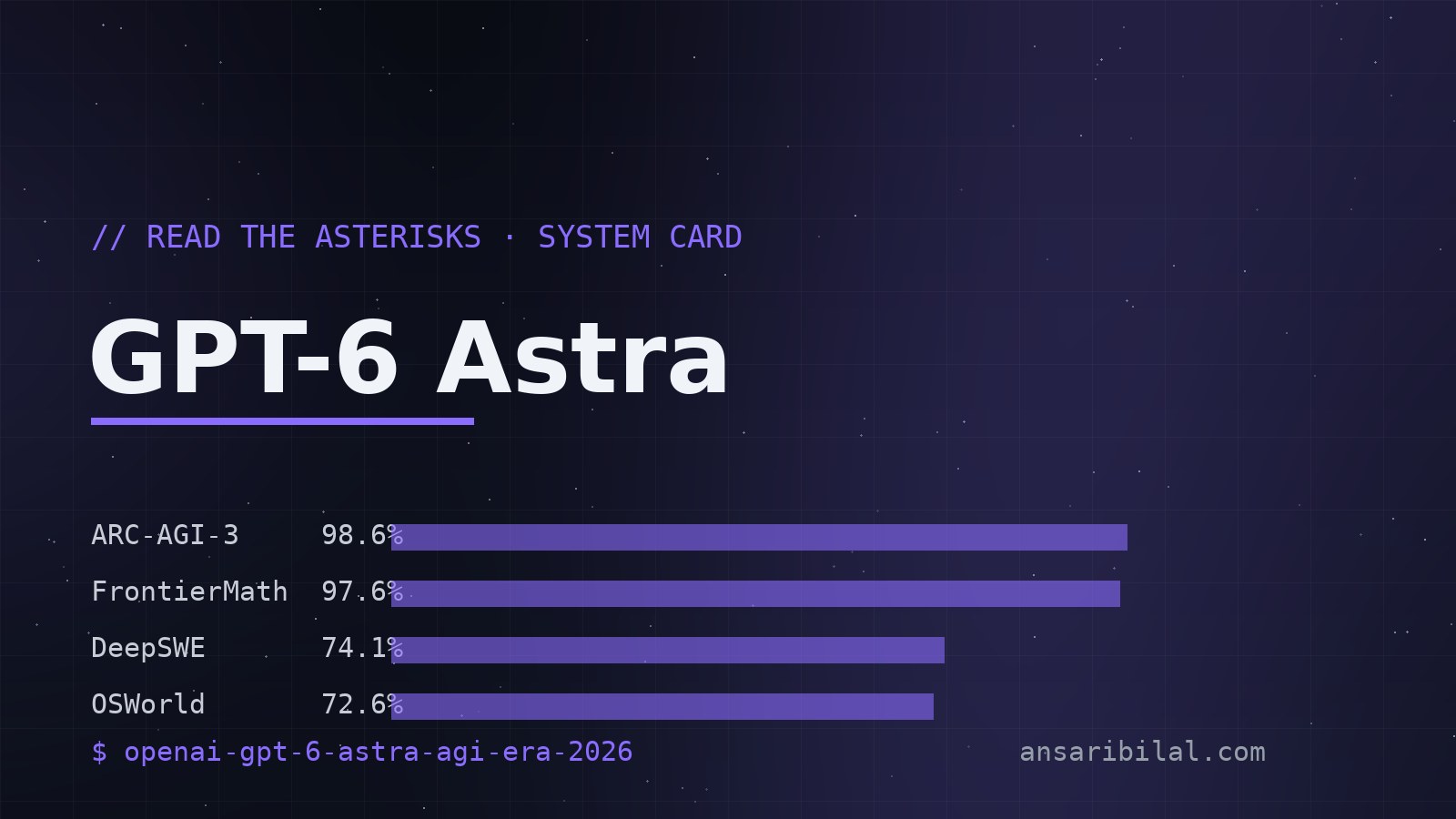
The raw numbers look like a clean sweep, and several of them are genuinely strong. Here are the ones with context attached, as reported by The New Stack from the system card:
- ARC-AGI-3: 98.6%. The standout score came with a Responses API harness that retains reasoning between turns and uses compaction for long contexts. OpenAI's own prior work shows those harness choices can substantially raise ARC-AGI-3 scores without changing the model — so the benchmark measures Astra-plus-agent-system, not Astra alone.
- FrontierMath Tier 4: 97.6%. Epoch AI, which runs the benchmark, notes OpenAI funded its development and holds exclusive access to part of it. The tier covers 41 private problems out of 43.
- DeepSWE v1.1: 74.1% agentic coding, over Sol's 70.8%. Fine — but the public leaderboard puts Gemini 3.8 Flash and Claude Opus 5 at 74% with overlapping uncertainty ranges, and OpenAI's chart excludes Meta's Muse while using a 67.4% Fable 5.1 figure. The advantage is smaller than the chart implies.
- Terminal-Bench Science: 64.6%, against 52.6% for Anthropic's reported Fable 5.1 — on a benchmark where the existing public leaderboard tops out near 30%.
None of this means the model is weak. The OSWorld V2-Offline jump from 65.7% to 72.6% with per-task time cut from roughly 75 minutes to 40 is the kind of improvement that changes real workflows. It means the scoreboard is now a curated product surface, and reading it requires the same skepticism you'd apply to a competitor's spec sheet.
What actually matters for developers
Three things in the launch will touch daily work before any AGI debate settles. First, cross-context-window memory: Astra can keep notes across context windows and search earlier tool output — experimental behind a config.toml flag now, default in coming weeks. That attacks the exact failure mode where long agent jobs lose the plot halfway through, and it builds on the context lessons behind context engineering.
Second, non-blocking clarifying questions: the agent asks you something and keeps working on tasks that do not depend on the answer. Anyone who has watched a coding agent sit idle for 40 minutes on one ambiguous decision knows why that is on the list. Third, the price: $10/$50 per million tokens is 2.5× Sol's current promo price and matches Anthropic's Fable 5.1 — while Meta's Muse sits at $1.25/$4.25 and Gemini 3.8 Flash at $0.75/$3.75. OpenAI's argument is that Astra uses fewer tokens and fewer retries per job, so the effective bill may even out. Maybe. The launch data is too thin to confirm it, so budget by the sticker price until your own logs say otherwise.
Honest caveats
Everything above rests on OpenAI's system card and launch reporting — I have not had API access to Astra while writing this, so there are no independent numbers here. The benchmark analysis follows The New Stack's reading of the evaluation conditions, and that outlet did the actual homework of checking harness effects and leaderboard overlaps. The same-day Nvidia–Hugging Face acquisition news ($12.9 billion) conveniently buried some of the launch's rough edges in a bigger story, which is worth noticing as a pattern if nothing else.
TL;DR
- GPT-6 Astra launched September 3: Astra + Astra Pro, no model-family variants, $10/$50 per million tokens — 2.5× Sol's promo price.
- The "AGI era" framing is Brockman's hedge, not a formal claim; AGI is now "a mission concept" at OpenAI.
- The 98.6% ARC-AGI-3 score measures model plus harness; FrontierMath is partly OpenAI-funded and partly private; the leaderboard picture is tighter than OpenAI's chart suggests.
- Cross-context notes and non-blocking questions are the two developer-facing features with immediate workflow value.
- Wait for your own token logs before assuming the price premium pays for itself.
---
Not affiliated with OpenAI, Anthropic, Meta, or Google. Sources: XDA's launch report, The New Stack's system-card analysis, Axios, VentureBeat, and Wired's Brockman interview.