Insights
Google's Gemini Decision 1 Answers 1,000 Questions in One Pass — for $0.10 per Million Tokens (2026)
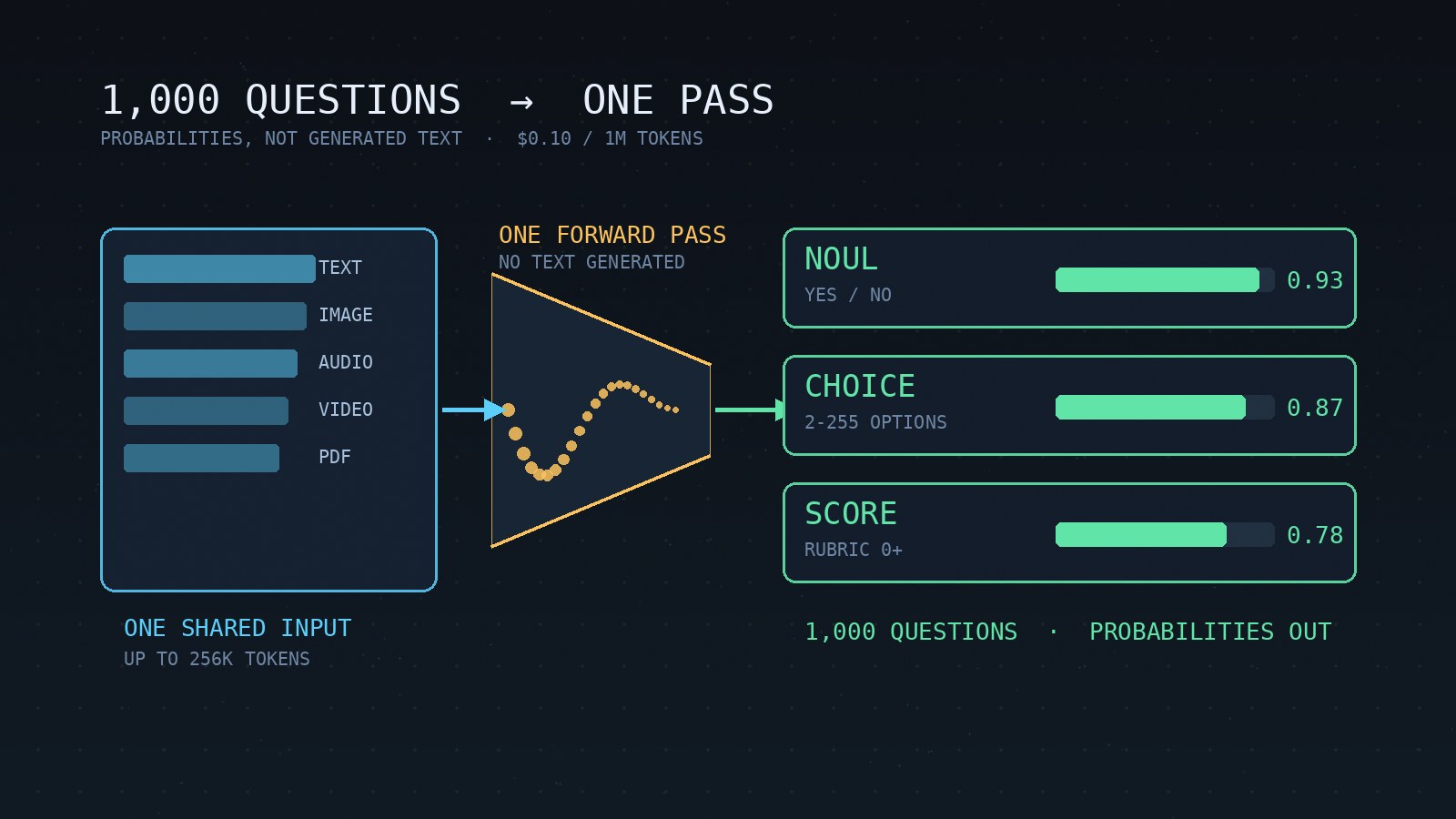
The Gemini Decisions API scores up to 1,000 bounded questions in a single forward pass — no text generation, no output tokens billed, 150–250 ms end to end. It is Google's answer to the decision-model wave OpenAI joined in October.
Last updated: November 13, 2026 · 3-minute read
Google says its new Gemini Decision 1 model can score up to 1,000 yes/no, multiple-choice, and rubric questions in a single forward pass. The Gemini Decisions API returns probabilities and confidence scores instead of generated text, with end-to-end latency of 150 to 250 milliseconds.
What the API Actually Does
Google announced the Gemini Decisions API on Nov 11, 2026, in a blog post by Min Choi and Felix Yu of Google DeepMind. The endpoint is powered by Gemini Decision 1 (model ID gemini-decision-1) and is available through the Gemini API in Google AI Studio.
Gemini Decision 1 evaluates up to 1,000 bounded questions over one shared multimodal input of up to 256K tokens. The input can include text, images, audio, video, and PDFs. Rather than generating answer text token by token, the model scores candidate options in one forward pass and returns probabilities plus a confidence score from 0 to 1. Developers can route low-confidence results to a fallback or a human reviewer.
The Three Question Types
The API supports yes/no questions with optional true and false criteria, choice questions with 2 to 255 options returning normalized probabilities for every candidate, and score questions that grade input across an ordered rubric starting at 0. Each answer includes a confidence score.
Latency and Price
Google reports end-to-end latency of 150 to 250 ms, with median model compute of 50 to 100 ms. Latency stays nearly flat from 1 to 100 questions per request across multimodal inputs and contexts up to 16K tokens.
Pricing is $0.10 per 1M input tokens and $0 for output tokens. The shared input is billed once per request regardless of question count. Google AI Studio offers a no-cost prototyping tier. Google claims the setup is nearly 5x cheaper than Gemini 3.5 Flash-Lite on the Interactions API across its shared benchmark suite; that is Google's own claim, not independent verification.
Performance Claims
On benchmarks spanning agent routing, reasoning, ranking, and multimodal understanding, Google says Gemini Decision 1 leads the suite with the lowest calibration error. Specific benchmark scores were not verified from the blog text and are not cited here.
Where Google Uses It Internally
Teams across Google use the Decisions API as a low-latency control plane. Gemini Notebook uses it as a real-time router, classifying intent in milliseconds and serving everyday queries with up to 40% lower latency while reserving deep reasoning models for complex tasks. That 40% figure applies to that one deployment, not the API generally.
Stitch uses it to generate playable wireframes and apply voice or tap edits almost instantly. CC from Google Labs picks emoji reactions from a palette of more than 200 options. Google Search uses it as a safety layer for MCP tools to detect adversarial behavior and content.
Ecosystem and Availability
Integrations are rolling out across OpenRouter, LangChain, Vercel, LiteLLM, Pydantic AI, Pipecat, LiveKit, and OpenCode, alongside the google-genai SDKs. Python, JavaScript, and REST guides are in the Decisions API documentation in Google AI Studio. Demo apps include Doorstep Parcels, Speed Sketch, and Find the Zoo Keeper. The endpoint is v1beta on the Gemini Developer API only; support for Gemini in Google Cloud is coming soon with no date given.
Versus OpenAI's Decisions API
OpenAI's Decisions API went generally available on Oct 22, 2026, running on gpt-6-luna. Its pricing and question cap come from outlets citing OpenAI's own pricing page and developer guide, so they are reported figures rather than claims from Google. The comparison is limited to price, question cap, and input modalities.
Read more AI agent coverage on /blog, or explore work in /#projects.
---
Not affiliated with Google, OpenAI, or TypeSafe. Sources: Google, OpenAI (reported prices).