Tutorials
Agent Deck Puts Every AI Coding Agent in One Terminal (Setup Inside)
One TUI for Claude Code, Gemini CLI, Codex, OpenCode and more. Buried Treasure №2 covers sessions, git worktrees, and why 840 stars undersell it.
Last updated: September 10, 2026 · 6-minute read
Running four AI coding agents means four terminal tabs, four lost contexts, and four moments a day where you type the wrong thing into the wrong session. Agent Deck — a Go-based terminal session manager for Claude Code, Gemini CLI, Codex, OpenCode, Aider, and friends — collapses that mess into one TUI, and it is doing so at a pace most bigger tools would envy: version 1.15.0 shipped August 23, with releases landing roughly every week since the project appeared in December 2025.
Why a session manager became necessary
The unit of AI-assisted development stopped being the command and became the session. A long agent run is a stateful thing — its context, its git branch, its uncommitted changes, its half-finished plan. Terminals handle one stream of text well and six of them badly. Every serious agent user I know eventually reinvents the same scaffolding: tmux panes, naming conventions, sticky notes about which agent owns which worktree.
Agent Deck's pitch is that this scaffolding should be a product, not a ritual. The repo describes it as "one TUI for Claude, Gemini, OpenCode, Codex, and more" — and the GitHub topic list (mcp, tmux, session-manager, aider, gemini-cli, bubble-tea) shows the design brief: native sessions for the major agents, tmux-class workflow, MCP-aware, built in Go on the Bubble Tea framework. It is MIT-licensed, cross-platform (macOS, Linux, Windows), and sits at about 840 stars with an unusually active issue tracker for its size.
What it actually does
Three capabilities carry the tool, all verifiable in the README and release notes rather than marketing copy:
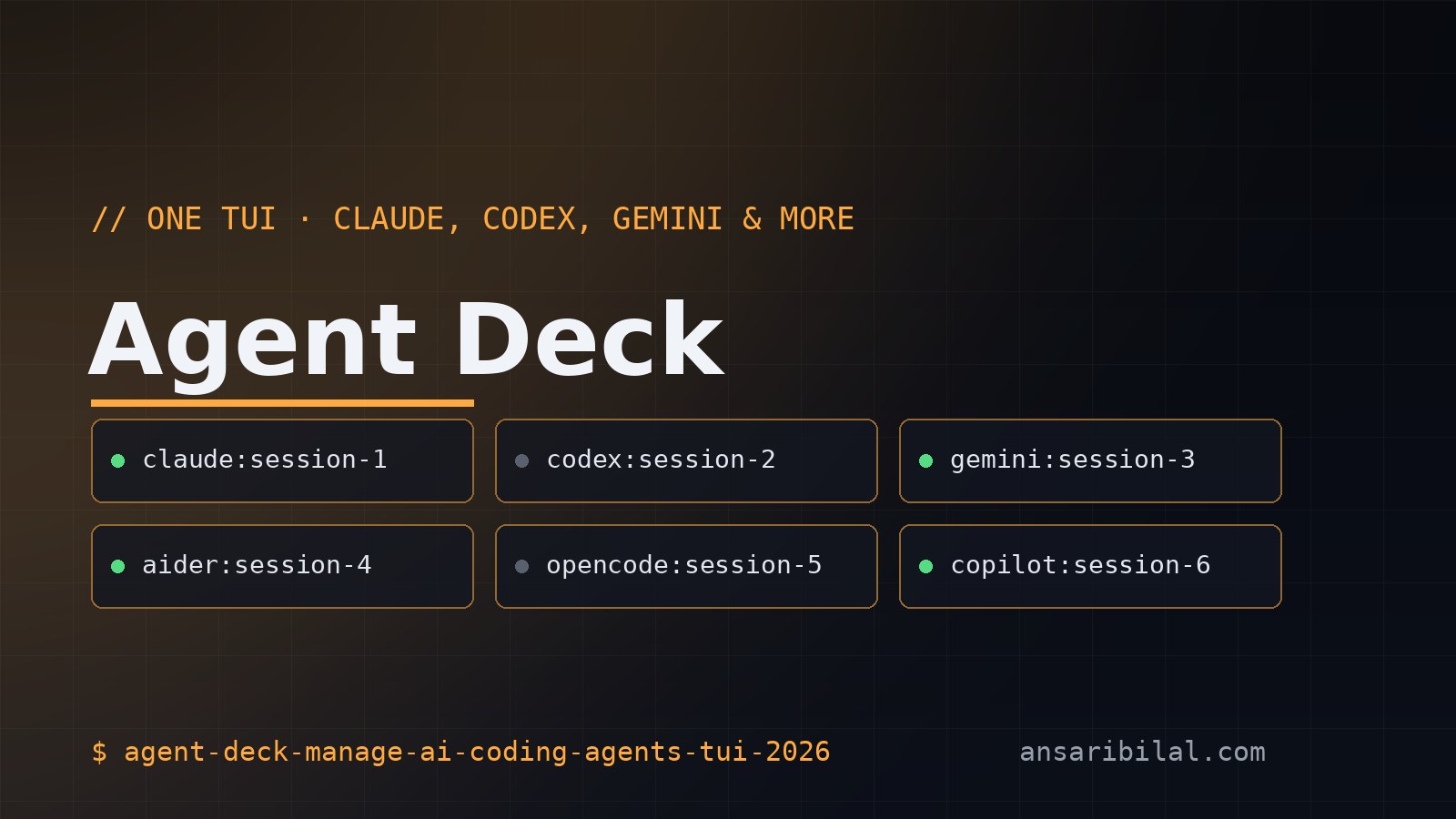
- One surface, many agents. Launch, monitor, and switch between Claude Code, Gemini CLI, Codex, OpenCode, Aider, and other CLIs from a single keyboard-driven view. Sessions are first-class objects with names, states, and history instead of anonymous terminal tabs.
- Session lifecycle that survives interruptions. Detach and reattach without killing a running agent — the tmux mental model, applied to agent runs, which is precisely where tmux's generic approach falls short of agent-specific needs.
- Worktree-friendly organization. The topics and docs treat git worktrees as a first-class pattern, which matches how careful agent users actually work: one agent per worktree, isolated changes, no cross-contamination.
Version 1.15.0's changelog shows the cadence translating into substance — the project has been iterating on session handling and agent integrations week over week since its first tagged release. For a tool barely nine months old, that release history is the strongest quality signal available.
Try it in five minutes
Then point it at the agent CLIs you already have installed:
The exact subcommands vary slightly by version — the README's quick-start is current and honest about platform quirks. If your setup matches my agentic workflow stack, the natural pairing is one Agent Deck instance per project directory, with persistent memory handled separately by an MCP server — the tools solve different halves of the same problem.
Honest caveats
Project age first: Agent Deck is young, and a tool that manages your most expensive workflows earns distrust by default. The counter-evidence is concrete — weekly releases, a large issue tracker with visible maintainer engagement, and MIT licensing that caps the cost of adoption. The second caveat is scope: this is a session manager, not an orchestration framework. It will not schedule agents, score their output, or replace CI. If you need pipeline-style orchestration, that is a different tool category. Third, the Discord-first support model will annoy people who want everything in GitHub issues — the repo is the source of truth, but the community lives elsewhere. And the obvious one: any terminal UI asks you to relearn reflexes; budget an afternoon, not five minutes, before it feels native.
I have not run Agent Deck against my own daily agent fleet yet — this writeup comes from the repo, its release history, and the README's documented flows, verified on September 5, 2026. The release pace is the reason it made the series: rarely does a 900-star-class project ship this consistently.
Who should install it
Anyone running two or more agent CLIs daily — the tool pays for itself the first week you stop cross-typing into the wrong session. Solo developers juggling parallel experiments get the most value; teams already standardized on one agent get less. The broader point for this series: the interesting projects of 2026 are not model releases, they are the boring-sounding infrastructure that makes models usable — the same reason MCP servers exploded. Next Buried Treasure: moving from your terminal to a VPS that behaves like your own private Heroku.
TL;DR
- Agent Deck is a MIT-licensed Go TUI managing Claude Code, Gemini CLI, Codex, OpenCode, Aider and other agent sessions in one place.
- Weekly release cadence since December 2025; v1.15.0 shipped August 23, 2026 — the strongest trust signal a nine-month-old tool can offer.
- Sessions are first-class: detach/reattach, named states, git-worktree-friendly organization.
- It is a session manager, not an orchestration engine — pair it with MCP-based memory, not instead of it.
- Worth it the moment you run two or more agents in parallel.
---
Not affiliated with Agent Deck, Anthropic, OpenAI, or Google. Sources: Agent Deck on GitHub — repo metadata, README, topics, and release history verified September 5, 2026.